
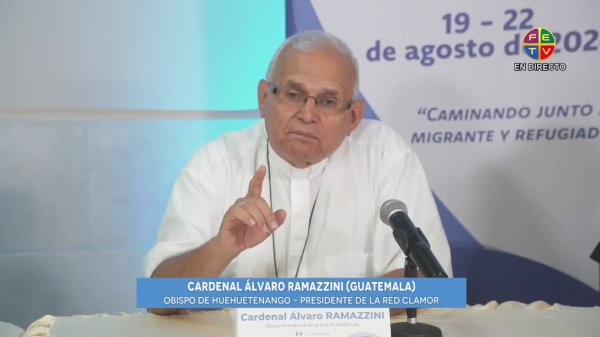
Rodolfo Soriano-Núñez Jueves, 22 de Agosto del 2024
Together with bishops from the United States and Panama, Ramazzini denounced the “death and destruction” on the Mexican border with Guatemala.
“I cannot understand how the Mexican government has lost control of that side of the border,” Ramazzini said at a press conference in Panama City.
By Rodolfo Soriano-Núñez
Bishop Álvaro Leonel Ramazzini Imeri, a Guatemalan Cardinal of the Roman Catholic Church, issued in Panama one of the most severe criticisms of the performance of the Mexican government in the current conflict in the state of Chiapas, on Thursday, August 22nd.
"We are in an area where the drug cartels have total control. I cannot understand what the Mexican government has failed to do to have reached this point of losing total control of that side of our border."
A little further on, Ramazzini, appointed as Cardinal by Pope Francis in 2019, said:
"Today, for us, crossing the Mexican border in Chiapas poses a very serious danger; not only because of these cartels kidnaping average persons, forcing them to pay ransom, and in many cases involving them in the war that the Jalisco Nueva Generación and Sinaloa cartels are waging with each other.”
Part of Ramazzini's accusation is on the video appearing after this paragraph, produced by the television station of the Roman Catholic Archdiocese of Panama.
Excerpt from the press conference of the 10th Meeting of Bishops and Pastoral Migration Agents. August 22, 2024. Audio available only in Spanish.
The full video is available, only in Spanish, at the FETV page, the television station of the Roman Catholic Church in Panama, on Facebook.
Later in his message, Ramazzini makes it is clear how difficult is for him to watch the suffering leading thousands of persons to try to reach the U.S.-Mexico border, and how they now have to go through an area where, according to his estimation, of journalists on both sides of the Mexico-Guatemala border, and a few days ago of the former Roman Catholic bishop of Tapachula, the southernmost metropolitan area in Mexico, dozens of persons are finding death and violence.
Cardinal Ramazzini regretted that, in his opinion, the media does not report sufficiently on the situation that he described as “painful and dramatic” on the border between Motozintla in Mexico and Huehuetenango in Guatemala, as can be seen explained by Cardinal Ramazzini in the video after this paragraph, in which the cardinal goes so far as to affirm that criminal organizations “do whatever they want” without the Mexican authorities intervening.
Excerpt from the press conference of the 10th Meeting of Bishops and Pastoral Migration Agents. August 22, 2024. Audio available only in Spanish.
Although Ramazzini recognized that the situation in Darien, Panama is very difficult due to the dangers posed by the jungle in that region of Panama, he estimated that the situation on the border near Motozintla, Mexico and Cuilco, Guatemala, is unsustainable.
He made it clear, as seen in the video that appears after this paragraph, that the attacks by criminal drug organizations in Mexico not only affect migrants from other countries who cross there in the hope of reaching the border with the United States, but also affect the Mexican civilian population.
Excerpt from the press conference of the 10th Meeting of Bishops and Pastoral Migration Agents. August 22, 2024. Audio available only in Spanish.
Motozintla, Mexico is located just under 80 kilometers or 50 miles west of Huehuetenango, Guatemala. Both towns, like others in that area of the common border, are connected by Guatemala's Highway 7W, which begins in Huehuetenango and becomes, upon crossing to the Mexican side, in the town of La Mesilla, Highway 190, which in turn connects Motozintla with San Cristóbal de Las Casas, as can be seen on the map that appears after this paragraph.
In the last year, the state of Chiapas has seen the number of homicides skyrocket. According to data from the Mexican authorities, Chiapas and Tabasco are the two states in Mexico where homicides have increased the most between 2023 and 2024, as can the graph below, taken from TResearch International de Mexico, corresponding to yesterday, Thursday, August 22, proves.
For the state of Chiapas, the graph reports an increase in the number of homicides of 139 percent when compared to the murders reported back in 2023.
Ramazzini, who is the bishop of Huehuetenango, Guatemala, made his appeal at the 10th Meeting of Bishops and Migration Pastoral Agents of the Latin American and Caribbean Ecclesiastical Network on Migration, Displacement, Refuge, and Human Trafficking, which Ramazzini himself presides.
The network supports various projects that seek to provide support for those trying to reach the United States as asylum seekers for political or other reasons. Its website is available here.
Just in July of this year, the Network published the document available in Spanish in the box after this paragraph. There one can read the account they offer of how dreadful is the situation of migrants who try to reach the U.S.-Mexico border.
Decalogue of requests to representatives, deputies, ministries, and institutions of Colombia and other countries of the region, CLAMOR. Available only in Spanish.
Roman Catholic bishops from the U.S., Mexico, Central America, and other regions attended the CLAMOR 10th meeting from August 19 to 22 in Panama City, capital of one of the countries suffering the most from the effects of a global crisis in the so-called Darien Strait, where people from all over the world try to reach from there the border between Mexico and the United States.
At the press conference were also the archbishop of Panama, José Domingo Ulloa Mendieta, the bishop of El Paso, Texas, Mark Joseph Seitz, and the Costa Rican priest Gustavo Meneses Castro, responsible for the so-called Pastoral of Mobility at the Conference of Roman Catholic Bishops of Costa Rica.
The fact that Ramazzini is a cardinal, even though he occupies a small diocese on the border with Mexico, reflects Pope Francis's take on migration during his eleven years pontificate. He has tried to support dioceses in different countries that are facing the contemporary global scale migration crisis.
Pope Francis elevated Ramazzini to Cardinal back in October 2019, when Ramazzini was already 72 years-old in an equivalent way to how Francis himself later did with the bishop of San Diego, California, Robert McElroy, a promotion that used to be reserved for the leaders of the archdioceses in that US state, Los Angeles or San Francisco.
Recently, Los Angeles Press has reported on the extent of the violence in Chiapas, as well as the ability of criminal organizations to even set illegal “checkpoints” on the border between Mexico and Guatemala, just a few meters or yards from those of the National Guard and other federal authorities in Mexico.
We have also reported on how the former bishop of the diocese of Tapachula, the current archbishop of León, Guanajuato, Jaime Calderón Calderón, used his last message to the diocese of Tapachula to call out the violence ravaging the Guatemala-Mexico border and, above all, the indolent attitude of the Mexican authorities, both at the federal and state levels, in what, until a few months ago, was his diocese in Chiapas. The story is available only in Spanish after this paragraph.
On Wednesday, August 21st, Cardinal Ramazzini himself, his colleague, Bernabé Sagastume, bishop of San Marcos, Guatemala, Rodrigo Aguilar Martínez, bishop of San Cristóbal de Las Casas and in charge of the archdiocese of Tuxtla Gutiérrez, both in Chiapas, Mexico, and José Guadalupe Torres Campos, bishop of Ciudad Juárez, Chihuahua, and head of the Pastoral of Human Mobility at the Mexican Conference of Roman Catholic Bishops, published a call to postpone the special elections that are to be held in the coming days in some municipalities of Chiapas, as well as—above all—to stop the wave of violence that is ravaging that state in Mexico.
In addition to pointing out that there are no conditions for holding special elections there, they called on the generators of violence to stop and on the Mexican government to disarm and dismantle criminal organizations.
The statement appears in Spanish as an image before this paragraph or can be read on the Facebook account of the Diocese of San Cristóbal de Las Casas.
The story linked next, available only in Spanish, goes over what Pope Francis has been doing on migration during his tenure.