
Rodolfo Soriano-Núñez Miércoles, 11 de Diciembre del 2024
Late Cardinal Obando’s dangerous relations with Daniel Ortega keep taxing the Catholic Church and its religious orders in Nicaragua.
In suppressing the Jesuits a year ago and chastising now other religious orders, Ortega confirms the warnings issued ten years ago by the Jesuits about Obando’s dangerous dealings with power in Nicaragua.
By Rodolfo Soriano-Núñez
Back in August 2023, Los Ángeles Press published a Spanish-only piece about the then recent suppression of the Jesuits, the so-called Society of Jesus, the male religious to which Pope Francis has been affiliated for most of his adult life.
Last week, Ortega’s regime issued new laws and policies setting harder restrictions on the kind of work his government is willing to allow. Female religious orders are the main targets of these changes affecting also non-governmental organizations receiving funds from other countries.
The new policies affect more than 1,500 NGO’s, religious groups, and Roman Catholic female orders. Overall, according to Deutsche Welle, the multilingual German public broadcasting service, a total of 5,600 grassroots organizations have been suppressed by Ortega since 2018,when most experts set the beginning of the radicalization of his regime.
Back on mid-November, Nicaragua expelled to Guatemala bishop Carlos Herrera Gutiérrez, chair of the Nicaraguan Conference of Catholic Bishops. He is still, at least on paper, the bishop of Jinotega.
A Franciscan, Pope Benedict XVI appointed Herrera Gutiérrez as bishop of Jinotega in June 2005. He is already 75 years old, so Pope Francis could appoint a new bishop to the diocese in the near future, but chances are that will not happen as to prevent the notion that Rome is somehow in agreement with the expelling of Herrera Gutiérrez and other bishops, priests, and nuns.
Out of the same diocese of Jinotega, located 73 miles or 116 kilometers North of Managua, the country’s capital, at the end of November, Ortega's regime also expelled Father Asdrúbal Zeledón Ruiz. Ortega’s regime originally arrested Zeledón Ruiz by the end of September and expelled him on November 29th.
Zeledón Ruiz was the pastor of the National Sanctuary of Our Lord of Esquipulas, also known as the Black Christ of Esquipulas, a deeply popular Catholic devotion from Chiapas in Mexico, all the way down to Costa Rica, and he was perceived as an influential figure in bishop’s Herrera Gutiérrez local curia.
What follows is an updated version of the original piece in Spanish from August 28th, 2023.
A new suppression of the Jesuits
In the last two weeks, the already tense relationship between the Church and the State in Nicaragua worsened when Daniel Ortega's government confiscated the properties of the Society of Jesus, including the Central American University of Nicaragua, while ignoring the existence of that religious congregation. The Catholic and other media in Spanish, English and other languages has condemned the Ortega government's measures.
The UCA page linked in the previous paragraph, by the way, corresponds to the Internet Archive, since the page itself, its servers, are not available, at least not when consulted from Mexico or the United States.
The decision to withdraw or rescind the “non-for-profit legal status” of the Society of Jesus is reminiscent of the measures after the enactment of the 1917 Constitution in Mexico: the only thing they achieved was to create the fiction that something that, exists was not real for the purposes of the law.
Below is the PDF with the two pages of the decree published by the government of Daniel Ortega this Wednesday, August 23, 2023, by which the Society of Jesus in Nicaragua does not exist anymore. The full edition is available here.
The full decree suppressing the Jesuits in Nicaragua, August 2023. Available only in Spanish.
However, unlike Mexico in the 1910s and 1920s, where Church and State had lived in conflict, open or hidden, in Nicaragua the conflict with the Church follows a period in which the Church did everything within its power to strengthen Ortega’s regime.
In fact, Ortega's decision to suppress the Jesuits and to hinder by various means the operation of the UCA and several other religious orders, even the female ones, which tend to be much more modest than their male counterparts, occurs after a period of very intense collaboration between the Church and the State.
That period occurs, at least, from the beginning of the 2000s until 2018 when Cardinal Miguel Obando Bravo dies.
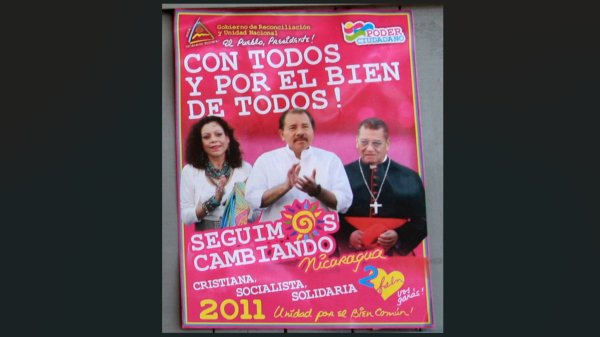
A previous story published by Los Angeles Press, available only in Spanish, offers the evidence about the kind of collaboration and mutual support that the Church, especially Cardinal Obando and those closest to him in the Nicaraguan episcopate, gave to Ortega’s regime. Such support explains many of the problems the Church in Nicaragua confronts these days.
This is not to justify what Ortega has been doing. Ortega’s choices over the last three years only prove that he has always been, at his core dictator, a caudillo, unwilling to dialogue. For many years, Zoilamérica Ortega Murillo, the daughter of his wife with a previous partner, current Vice President of Nicaragua, Rosario Murillo, has accused Daniel Ortega of sexually abusing her.
The problem is that Ortega's propensity to abuse the power at his disposal was known.
The warnings
It was known that Ortega was not trustworthy, not because he had been (that is, depending on who you ask) “leftist.” He was not trustworthy because from the time he held the highest positions in the Nicaraguan government after the fall of Anastasio Somoza, he exhibited the same personality traits, the same tendencies to abuse public institutions that are now more evident because of what is happening with the Church, but that were there at least since the eighties, when Sandinismo took power and then disintegrated into controversies among its main leaders, most of whom agreed to criticize Ortega’s excesses.
There are testimonies of Sergio García Ramírez, who was a leading figure of the first Sandinista government, the so-called National Reconstruction Government Junta with Ortega himself.
It should have been enough for the leaders of the Roman Catholic Church in Nicaragua to hear the voices of many in the Latin American left when they used to criticize the excesses of the Sandinista Front and Ortega.
We also knew this thanks to the testimony of those who combined their militancy in Sandinismo with their convictions as Catholics, as in the case of Ernesto Cardenal, whose militancy in the first triumphant Sandinismo cost him the sanction of Rome that prevented him from serving as a priest for almost a four decades.
Father Cardenal repeatedly pointed out Ortega's excesses until his death. Only death could silence him, but Ortega's partner in the Catholic Church, Cardinal Obando, far from listening to the criticism, insisted on deepening his symbiotic relationship with Ortega. What is worse, he did everything possible to ensure that Rome maintained its punishment of Father Cardenal.
One must keep in mind that just as Rome only accepted archbishop Oscar Arnulfo as a martyr and a Roman Catholic saint after his enemies, Colombian cardinals Darío Castrillón and Alfonso López Trujillo, died, Rome only rehabilitated Father Cardenal as a priest seven months after Obando’s death (June 3, 2018), on February 18, 2019.
The Obando-Ortega relationship was so solid because Ortega was willing to give Obando what most of the bishops during the pontificates of John Paul II and Benedict XVI asked for: stern anti-abortion laws that, in the case of several Latin American countries, included from the late nineties to the end of the last decade, prison sentences for women who suffered an abortion, even when they were natural or spontaneous abortions.
The sponsoring Cardinal
However, the relationship between Ortega and Obando ran deeper. Ortega actively promoted figures close to Obando to key positions in the Nicaraguan judiciary. These figures came from Cardinal Obando's favorite university, which was not the Jesuit Universidad Centroamericana de Nicaragua, UCA for short, too liberal for his appetite.
That honor belonged to the Catholic University Redemptoris Mater, that is, Mother Redeemer, one of the titles with which the Roman Catholic Church celebrates Mary, the mother of Jesus, when someone prays a rosary.
Unlike what happens with the URL of the Jesuit university, the UCA, the URL of UNICA, the university created by Cardinal Obando and those closest to him in Managua operates without any trouble.
This 2022 story offers an account of the role of that university, the so-called UNICA, as a key element in shaping a network of 15 judges and district attorneys who diligently executed Ortega’s orders, including those of confiscating the properties or assets of the religious orders of the Catholic Church.
In one of its paragraphs, it says, regarding Obando's relationship with UNICA and the insertion of its graduates in the judicial apparatus of Ortega's Sandinism:
Judge Ángel Jeancarlos Fernández is part of the network of graduates of the Catholic University Redemptoris Mater (UNICA), founded by the late Cardinal Miguel Obando y Bravo, and directed by the family of former magistrate Roberto Rivas —ally of the regime and former president of the Supreme Electoral Council—. In April 2018, days before the opposition protests broke out, his school congratulated him on its Facebook account for his performance as the first local criminal judge of Managua.
In other words, the judges who now validate Ortega’s laws and policies against the Society of Jesus and other religious orders in Nicaragua are not only following laws approved in the legislature when Obando was campaigning in massive events of the Sandinista National Liberation Front, where he went to celebrate masses in which, as a lackey, Ortega approached to take communion.
The Judiciary built by Ortega with lawyers close to Cardinal Obando accepted, legitimized, and executed Ortega’s wishes. UNICA’s ley role is more evident when one considers how, for example, as late as 2016, the Ortega regime celebrated Obando as Ortega’s partner making possible for the caudillo to turn into what is now: a dictator.
Hero of peace
On March 11th, 2016, UNICA was the venue for a tribute to Cardinal Obando. The then president of the Nicaraguan Legislature, René Núñez Téllez, gave Obando the so-called “autograph” of Law 924, which declared Obando a “Hero of peace and reconciliation” in Nicaragua.
All the major players of the nation’s judiciary were in attendance to celebrate Cardinal Obando. In the photo below, in the front row of the UNICA auditorium, from left to right, are the magistrates José Adán Guerra Pastora, Ileana Pérez López, Armando Juárez López, Rafael Solís Cerda, Francisco Rosales Argüello, as well as Marvin Aguilar García.
Also in the photo are the director general of the National Police, Aminta Granera Sacasa; the inspector general of the Army, Major General Adolfo José Zepeda Martínez; the aforementioned Roberto Rivas and the Chief Justice of the Supreme Court of Justice, Alba Luz Ramos Vanegas.
The photo comes from the Nicaraguan Judiciary's website available in its original location here and here at the Internet Archive.
In another photo taken from that same tribute, you can see the moment when the president of the Legislature, Núñez Téllez, was handing over the document celebrating Obando who, as was often the case with him, accepted the praise given to him by Ortega’s underlings.
In a third picture taken from that same page, Judge Rafael Solís Cerda embraces Cardinal Obando at the conclusion of the ceremony held at the UNICA headquarters in Managua. Solís Cerda is one of the few judges who has broken with the Ortega regime. On January 8th, 2019, Solís resigned from his position, although the official press presented the fact as a dismissal.
Unfortunately, Solís himself had a history that was less than worthy. The Nicaraguan press had reported on how he seized land and how he used the enlarged property to obtain loans from a bank that, years later, went bankrupt. Solís is now a refugee in Costa Rica.
Any criticism of Ortega’s current attacks on the Jesuits and other religious orders in Nicaragua must acknowledge Obando’s role in building what was at the time a theocratic relationship between the Roman Catholic Church and the Ortega regime.
Prince of the Church
Ortega’s attacks happen by means of laws and administrative or judicial resolutions accepted now by Ortega’s underlings who for years showered Cardinal Obando with praise, who celebrated the Prince of the Church's "Name day", the so-called “Santo” and birthdays as if they were celebrations of the civic-political calendar of the Central American nation.
And the relationship was close with bishops other than Obando. Although he has now distanced himself from Ortega, Obando's successor in the archbishopric of Managua, Cardinal Leopoldo Brenes, used to receive the support of the Ortega Judiciary Branch too, as this other page from 2014 reports, when talking about a visit by the full Supreme Court to the offices of Archbishop Brenes, after he was elevated to Cardinal by Pope Francis.
And it was not just the Judicial Branch. The Nicaraguan Armed Forces also took advantage of any opportunity to celebrate Cardinal Obando. In this image you can see a page from the institutional magazine of the Armed Forces of the Central American nation from 2012. There you can see the way in which Obando celebrated the Army emanating from the Sandinista revolution on its 33rd anniversary.
Here a PDF copy of the Nicaraguan armed forces magazine, source of the image above.
Special issue of the Magazine in full. Available here.
The Nicaraguan regime is, from any angle, abusive, it violates the human rights of its citizens, which is condemnable. But these abuses do not happen all of the sudden.
To achieve its own goals, the Catholic Church in Nicaragua helped Ortega set a subservient Judiciary, unwilling to respect human rights, saying “yes” to any request coming from Ortega, whose indefinite, limitless reelection was one of the many things that Obando was willing to bless because, again, there were coincidences that now the Church, especially in the United States, tries to minimize, but which are there for whoever takes the trouble to probe what has happened in Nicaragua over the last 20 years.
The Central American University, the Jesuit university in Managua, was one of the few public institutions with some institutional prestige that always remained alert about the possible consequences of the close relationship between Obando and Ortega.
A cleric of the State
Anyone who wants to understand what is happening in Nicaragua these days, must read Envío a service published over many years by UCA, the Jesuit university.
Especially, issue 397, from April 2015. There, the anonymous team of the journal warned those who worked in the archbishopric of Managua of the risks posed by the relationship with Ortega.
Obviously, no one listened to them or paid attention to them, perhaps because they made clear the damage, the “confusion,” caused by Obando’s attitude as a partner of power, what Pope Francis has called in other contexts the “state clerics.”
When Ortega returned to government in the 2006 elections, the strategy was proving its was effective. Ortega had supported the Free Trade Agreement with the United States. The FSLN business group had already grew in power and capital setting bridges with international capitals. The alliance with Cardinal Obando did the same in the religious field, although brought confusion in the Catholic people.
As it is often the case in the Catholic Church, whoever warns the bishops about the possible negative consequences of their actions is immediately considered a heretic.
At least for now, the spokesman for the Society of Jesus in Central America, Father José María Tojeira, has the support of the bishops of his and of other countries in the region when he says that “in Nicaragua there is no rule of law.”
In any case, it mush be clear that the new decision to expell religious orders will not affect only the Roman Catholic Church, or other Christian churches or, more broadly, religious institutions. It affects any civil or social organization or group receiving any kind of help or support from the exterior, even if only material, that Ortega's regime is able to frame as contrary to the regime.
.