
Rodolfo Soriano-Núñez Jueves, 01 de Mayo del 2025
Becciu, Cipriani, Mahony, Rivera Carrera, Stella, and Philippe Ouédraogo, are only some of the Catholic leaders desperate to derail the credibility in their own Church.
Lack of clear and consistent measures of discipline makes it almost impossible to believe in the Catholic Church commitment to a policy of zero-tolerance to abuse.
By Rodolfo Soriano-Núñez
In the original design, the Conclave’s current configuration has two weeks between the death or resignation of a reigning pontiff and the start of the election to appoint his successor. In theory, it is a time to grieve and reflect on the recent loss of the bishop of Rome and the need to elect his successor.
One could say that back in 2005 and 2013, some of that happened. Instead of the awful conditions in which the two conclaves of 1978 (August and October) happened, in 2005 the Cardinals who elected Benedict XVI as bishop of Rome, had the chance to sleep in a bed in a somewhat private space, instead of the barrack-like arrangements of yore.
The General Congregations allowed the older than 80 Cardinals to play an active role in the process, as said meetings are not under the rules of secrecy that exist for the actual balloting process during the Conclave, where Cardinals are secluded, and are unable to have contact with people outside of the Casa Santa Martha and the Sistine Chapel, where the actual balloting happens.
And yet, this year we have been witness already of at least three rather regrettable episodes clouding the Conclave and reinforcing the idea that the Catholic Church is unable to rule itself.
It is not as if it was unable to produce elaborate procedures for pretty much any imaginable thing. It is that the rules regulating such procedures have so many holes, loops, and lacunae, that any impartial observer of the process has to wonder why there are so many loops.
And on top of that, there is the issue of the unbridled appetites of the Cardinals, unable to control, restrain themselves, and very willing to throw the most significant process of institutional reproduction of their own Church into a spiral of doubt and uncertainty.
A few days ago, Los Angeles Press offered some details of Giovanni Angelo Becciu’s case, and how he was willing to threaten Pope Francis himself with a lawsuit in Italian courts for the damage to his reputation and for preventing him from having a chance at being Pope.
He never actually went that far, but the fact is that he issue such a threat against Francis, the Pope who entrusted him to play a key role in the offices of the Secretariat of State of the Holy See, right under Pietro Parolin.
Fame, prestige, and power
Right after Pope Francis’s funerals, Becciu went back in his desperate chase for fame, prestige, and power. He told the Italian press about his intention to attend the Conclave as an elector.
The top Vatican authority during the so-called Vacant See, the Dean of the College of Cardinals, Giovanni Battista Re, was able to talk Becciu out of such attempt, so Re was able to dismantle the first booby-trap, but only for others to emerge.
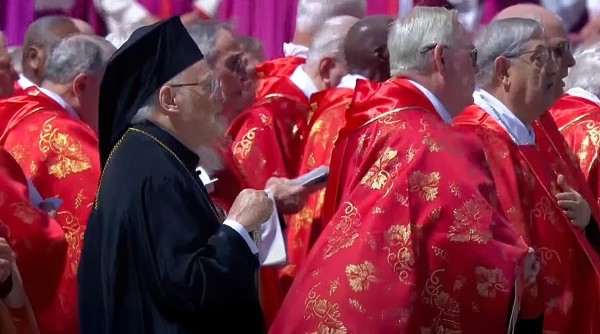
During Pope Francis’s funerals Rome witnessed, dressed in full Cardinal regalia, many names too familiar for the grassroots groups representing survivors of clergy sexual abuse.
There are reports about Mexican Cardinal Norberto Rivera Carrera being there at Saint Peter’s Basilica, as there are of his friend, the emeritus archbishop of Los Angeles, California, Roger Mahony, attending public functions in full Cardinal regalia, as if there was no record of the institutional cover up of U.S. and Mexican predator priests hurting the parishes of Los Angeles, the most populous U.S. Catholic diocese.
Already in March 2010, Benedict XVI appointed now archbishop Horacio Gómez Velasco as coadjutor and one year later, the then Pope, accepted Mahony’s resignation as soon as he turned 75 in a clear sign of the negative effects of his tenure as archbishop in Los Angeles.
As in other cases, Benedict XVI set some restrictions on Mahony’s public ministry, but there is no official record of it.
As if to corroborate how contradictory Rivera Carrera’s exercise as religious leader was, while he was attending religious services in Rome, Mexican media published information about how he was able to beat the local government of Mexico City in a dispute for taxes over the acquisition of two luxury condominiums in that country’s capitol city.
Rivera Carrera’s name emerged during the trials in U.S. courts of Mexican predator priest Nicolás Aguilar Rivera (no family ties). Nicolás Aguilar was a priest at the Mexican diocese of Tehuacán, in the Mexican state of Puebla. When Norberto Rivera Carrera took over that diocese, back in 1985, he saw fit to send Nicolás Aguilar Rivera to spend some time as priest serving Mexican and Latino communities in Los Angeles, California.
When the accusations emerged, as per the standard operating procedure of the Catholic Church, Norberto Rivera Carrera denied being aware of Nicolás Aguilar Rivera’s weaknesses, despite testimonies on the contrary not only from survivors of clergy sexual abuse, but also from other Catholic priests, some of them now former priests, in Mexico who claimed Cardinal Rivera Carrera was well aware of Nicolás Aguilar Rivera’s long record as a predator.
The Mexican connection: protecting predators in LA
Those sources also claim that after the accusations emerged against Nicolás Aguilar Rivera in the United States, Cardinal Rivera Carrera, then the all-powerful archbishop of Mexico City, helped the priest to find rural parishes in the State of Mexico, the most populous state in Mexico, circumventing the country’s capital, to find temporary assignments as to keep himself active as a priest.
A timeline developed by the law firm of Jeff Anderson & Associates in the U.S. has Aguilar Rivera going from an initial development as priest from 1970 through 1987 in Tehuacán, with some time spent too at San Sebastián Cuacnopalan, in the same state of Puebla.
In 1987, he had his first stint at Our Lady of Guadalupe, in Los Angeles, from where he went to Saint Agatha’s, also in Los Angeles.
From 1988 through 1995, Aguilar Rivera spent time at different parishes in Central Mexico. That year, he went back to Tehuacán, at the parish of Saint Vincent Ferrer and Saint Nicholas in Tehuacán, Puebla.
There is a gap in the record between 1996 and 1998. The next year, 1999, he appears as an associate at Saint Michael in Mexico City, Mexico. There is a larger gap between 2000 and 2008, with no official assignment, but with testimonies of people in Mexico attending ceremonies presided by him, despite the fact that Benedict XVI will laicize him in 2009.
In this respect, even if Roger Mahony and Norberto Rivera Carrera were not the only bishops responsible for protecting Nicolás Aguilar, the fact that they are going back to perform in public in Rome in full Cardinal regalia, only proves how disconnected they are from the effects of their behavior as leaders of their Church.
Both are older than 80, and none of them have a chance at pursuing some new assignment in their Church, but still, the fact that there is no clear stipulation regarding their behavior in public makes very difficult to see any attempt from the Catholic leadership at large to accept Pope Francis's notion of the “spirituality of reparation” that was his timid contribution to trying to acknowledge the true depth of the clergy sexual abuse crisis.
Peruvian vanity
In that regard, the situation with Juan Luis Cipriani Thorne, the emeritus archbishop of Lima, Peru, is even worse, as in his case a male survivor directly accused him of attack while Cipriani was a priest working for the Opus Dei religious “order” in Peru.
The Vatican made it clear back in January of this year that Cipriani was under some kind of extremely light “punishment,” the ultimate slap in the wrist. Sadly, instead of letting the world know about said “punishment,” the Holy See only let the world know about it when Cipriani decided to challenge Pope Francis.
Cipriani went into a tour de force in his former archdiocese of Lima. He accepted a prize from his fellow member of the Opus Dei and current mayor of Lima, Rafael López-Aliaga.
Even if by January of this year, the Vatican was willing to leak Cipriani’s file to Spaniard newspaper El País (see our story linked before this paragraph), as to let the world know of the punishment set by Pope Francis, the bishops of Peru were in no hurry to express some kind of support to then extremely ill Pope Francis, much less to condemn Cipriani’s chieftain-like challenge to the then reigning Pope.
They waited for more than two months to timidly acknowledge Pope Francis’s authority to set the limits on Cipriani’s activities in public in Peru and elsewhere, as the statement appearing after this paragraph proves, available only in Spanish.
The statement merely acknowledges the Pope's authority but leaves the door open to accept Cipriani's claim to innocence, contradicting the very idea, on the one hand, of the Pope as supreme judge of the Vatican and the Church at large, and all the easy-talk about trusting Peter's successor.
Ultimately, it proves that when it is about sexual abuse, clerics trust clerics willing to help them.
After Jorge Mario Bergoglio's death, Cipriani saw fit going back to play “fresh prince” of his church in the streets of Rome, for the Opus Dei’s delight, as the “order” founded by Spaniard priest Josemaría Escrivá de Balaguer seems to be at ease with Cipriani’s challenge to the now known will of Pope Francis.
African contribution
And given the global nature of the College of Cardinals, it would be impossible to expect no contribution to the ongoing pet zoo of horrors in the Vatican from the African wing of the college.
The only surprise is that this time around the excess is not coming from Guinean Cardinal Robert Sarah, known for having the support of big donors willing to contest whatever Pope Francis could say on any issue at any given point.
This time, the African contribution to the misery of the Roman Catholic Church comes from Burkina Faso, where the archbishop Philippe Ouédraogo decided at some point in the last couple of years to change his date of birth.
Catholic Hierarchy "scraps" and puts in HTML code the data coming from different official sources of the Catholic Church. Putting aside the historical data which is extremely complex to explain, the data for the active clerics and jurisdictions in that church comes from the so-called Annuario Pontificio, a book compiling information on appointments, resignations, deaths, and other events shaping the every day life of the Church.
More recently, its webmaster includes the data as published by the so-called Bolletino of the Holy See, an official summary with data on resignations, appointments, and other issues. Catholic-Hierarchy is extremely useful, very reliable, and consistent.
In its earliest iterations, back in the Aughts, then newly appointed bishop Ouédraogo used to appear as born on January, 25th 1945, as can be seen in the image before this paragraph, and at this URL taken from the Internet Archive back in 2003.
That same source, using the same tool provided by the Internet Archive had the same date of birth for then already archbishop and Cardinal Ouédraogo on January 2022.
It has been only now, when the Conclave to elect Pope Francis’s successor is about to happen that for some strange “miracle”, Ouédraogo appears as born on December 31st, 1945, giving him, a chance at being enrolled as cardinal elector of the Roman Catholic Church for the Conclave set to begin on May 7th, 2025, as the new date puts Ouédraogo under the Catholic “magic number” of 80, allowing him, at least theoretically, the right to cast a vote and even to be elected Pope.
Stories from the Global South
So far there has been no explanation as to how Ouédraogo was able to reduce his age, but people from the Global South, as the author of these lines is, are well aware of the many chances to buy counterfeited documents.
One of the most notorious cases of such practice involved the Mexican national soccer team in the 1980s. The global soccer leaders at FIFA barred Mexican national soccer teams in all divisions after news of the use of counterfeited birth certificates, the so-called "age fabrication" emerged in the late 1980s. FIFA issued a clear punishment that left the Mexican national soccer teams out of official competition for a full cycle of four years.
That happened despite the Mexican soccer league influence at FIFA at the time. FIFA was well aware of the devastating effects that such a scandal had on competitive sport.
The scandal shocked several generations of soccer fans in Mexico. It gave a new meaning to the Spanish-speaking word cachirul, and there are Wikipedia entries in both English and Spanish devoted to that, the most Mexican contribution to world soccer.
Baseball has had its own share of similar stories of “age fabrication” coming from Asia, the Caribbean, and the United States, also with its own entry in the Wikipedia. Every time the leaders of sports organizations catch teams with forfeited certificates of birth, as to allow the participation of older-than-allowed athletes in each year cohort, they have issued stern punishments.
They know about the pervasive effects that kind of behavior has on the enthusiasm with which people will attend their venues or send their kids to play that kind of sport.
Sadly, there is no expectation of an actual punishment against Ouédraogo. Quite the opposite. He will play the victim, to curry favor from the far-right Catholic media in the English-speaking world who, in exchange for some support for the “beauty of the Latin Mass” will be more than willing to turn him into a martyr.
But wait, there is more...
As I am writing these lines, new information from Rome comes about a statement made by Cardinal Beniamino Stella, the emeritus prefect of the Congregation of the Clergy and fomer nuncio, back in the 1990s to Cuba, who during this Wednesday April 30th, disparaged against Pope Francis’s decision to incorporate laypersons as members of the Roman curia, as in the case of Argentine layperson and professor Emilce Cuda, the secretary of the Pontifical Commission for Latin America.
Stella is almost 84 so, unless he pulls a similar trick to Ouédraogo in the coming hours, he will not be able to cast a vote in the Conclave, but he has publicly expressed support for Cardinal Pietro Parolin, a darling of most of the Italian wing in the Conclave. Italy has the most numerous delegation to the Conclave, as they have a total of 19 Cardinals.
Stella’s criticism of Francis decision to open the Roman Curia to laypersons, a trend that started with Benedict XVI when he appointed back in 2011 Uruguayan lay male Guzmán Carriquiry Lecour to a position similar to Cuda’s, is a stark reminder of how deep clericalism runs in the Catholic Church, but also of how frail were the alleged “radical” reforms sponsored by Francis.
Stella’s untimely comments highlight a resistance to a more collaborative and potentially more accountable form of governance within the Church. His implicit support for Cardinal Parolin, a figure deeply embedded in the traditional Italian Curial structures, further underscores the potential for the Conclave to resist significant reform.
The evidence presented so far, paints a troubling picture of a Catholic Church struggling to truly comply with the principles and rules it espouses. The actions of certain Cardinals in the wake of Pope Francis's death serve as a potent reminder that the wounds of the past – the abuse crisis and the subsequent cover-ups – continue to fester, hindering the Church's ability to move forward with integrity.
The Conclave represents a moment of potential renewal, allowing the Catholic Church to confront head-on ingrained issues of self-governance and accountability. The question remains whether the next leader of the Catholic Church will possess the will and the authority to enact the systemic reforms necessary to restore trust and truly embody the zero-tolerance policy so often proclaimed.
A view from Germany
It was when witnessing these and other developments that Matthias Katsch, a German survivor of clergy sexual abuse, former member of the Bundestag, the German Federal Parliament, and spokesperson for the so-called Eckiger Tisch, an organization in Germany advocating against sexual abuse, clergy and otherwise in their country and Europe at large, published a brief statement that is relevant to understand the kind of challenges shaping the upcoming Conclave of the Catholic Church. His statement, as translated from German, authorized by him, appears next.
Statement by Matthias Katsch
Berlin/Rome, April 30, 2025:
It is outrageous and at the same time revealing that, during the deliberations of the cardinals gathered in Rome, even those actually removed from office mingle with their colleagues.
In addition to the Italian Giovanni Angelo Becciu, who was convicted of fraud, these include the former Peruvian Archbishop of Lima, Juan Luis Cipriani, and the American Roger Mahony. The former Archbishop of Los Angeles was the first high-ranking cleric in the United States of America to appear in court to explain his comprehensive cover-up and continued protection of abusers in priestly robes.
Mahony, 89, was punished for his conduct during the abuse crisis in the United States of America. He is no longer permitted to exercise his functions as a bishop but remains a priest.
The Peruvian Cipriani, the first Opus Dei cardinal ever, was forced to resign by Francis and ordered to leave the country and not return to Peru as a condition of him having committed the abuse of a minor. He was explicitly relieved of his duties as a Cardinal, including the order to no longer wear the appropriate clothing.
All three cardinals now suddenly appear at the deliberations before the actual conclave in Rome, which are also attended by cardinals who are no longer eligible to vote in the conclave because they have exceeded the age limit of 80.
Cipriani, 81, and Mahony, 89, as well as Becciu, 78, apparently believed that after the Pope's death, they could now appear in public again and exercise their functions. Becciu initially insisted on participating in the papal election.
These cases demonstrate once again that the Church needs clear, transparent, and globally uniform procedures and regulations for dealing with clerical abusers and those who cover up abuses, procedures that are also reliably applied, even after the death of the reigning pope. As long as clear rules are not enshrined in canon law, the zero-tolerance policy announced after the 2019 Vatican abuse summit remains an empty promise.
Matthias Katsch
Managing Director and Spokesperson of Eckiger Tisch;
Co-Founder and Board Member of Ending Clergy Abuse.