
Rodolfo Soriano-Núñez Lunes, 28 de Abril del 2025
Despite Francis’s accomplishments in breaking away from clericalism, issues as the clergy sexual abuse crisis remain open
Francis left key issues as lose ends of his pontificate. Some of those lose ends come biting back at his Church now, right before the Conclave.
By Rodolfo Soriano-Núñez
On Monday, April 28th, the College of Cardinals decided to start the Conclave on Wednesday, May 7th, when they will face some of Pope Francis’s pending issues.
After Jorge Mario Bergoglio’s death, the Catholic Church is now on the first steps of the processes to elect a new Pope. The Conclave’s relevance is there for whoever is willing to acknowledge the Church’s role in public life in Latin America, Africa, Asia, the so-called Global South. But not only there.
Even if they contradict basic tenets of Christian theology, there is a clear influence of Catholic politicians in the far-right parties in power in the United States, Italy, and Hungary, as they do in countries such as Bergoglio’s native Argentina.

It is not as if one is dismissing the fact that there has been a secularization process in most of world. However, as intense as that process has been in the loss of significance of religious activities and thinking, there are also signs of a comeback of religious identities, attitudes, and practices that one should not dismiss.
The comeback is there in the political use of abortion and ideas about sex and gender. And even if the main beneficiary of that use of religious identity has been, by far, the political far-right in the U. S. with their zero abortion policies regardless of the consequences, there is also the case of Nicaragua case, where it was Daniel Ortega, the leader of the very leftist Sandinista movement, who offered back in the early years of this century what then Cardinal and archbishop of Managua, Miguel Obando Bravo and the Catholic Church wanted: a zero-abortion policy in exchange for the political blessing of what is, 20 years later, a dictatorship.

English Edition
The Catholic Church in Nicaragua: a new twist in the plot
In that respect, assuming that the outcome of the conclave is purely a religious matter would be naïve to say the least. Doing so would dismiss the ability the Popes and their Church have to boost or dismiss issues or specific cases or situation of crisis.
As timid and contradictory as the Vatican’s voice could be at times, it also serves as a reminder of issues otherwise dismissed by the global, industrial, media and other international actors, as it was with Francis’s and his take on the conflicts in Syria, Ukraine, and Gaza.
All-powerful papacy?
It is not as if one is expecting the reemergence of an all-powerful papacy, able to deploy troops or monies. When the papacy engaged in that kind of behavior it actually suffered its greatest loses, as during the different iterations of the Crusades.
It is just that as Francis’s papacy proved that it is better to have there a figure able to see through the double-talk of Vladimir Putin’s alleged adherence to Christian values reduced at his systematic hatred of the LGTBQ communities and whoever is willing to criticize in Russia his own ability to subjugate the clerics of the Orthodox Patriarchate of Moscow.
What follows is a take on the context in which this year’s conclave will happen. As such, this piece is fully aware of the infinite contradictions shaping the Catholic Church behavior, more so in issues directly shaped by its own behavior, as in the clergy sexual abuse crisis that, keeps ravaging different countries.

In that respect, and part of the context of the Conclave, three brief references to new developments. In Brazil, the country with the largest population of Roman Catholics worldwide, the victims of clergy sexual abuse were able to build a local network to mutually support themselves, following a similar path to their Argentine and Chilean fellow survivors.
Brazil is on a league of its own as far as the clergy sexual abuse crisis is concerned, as there is no official acknowledgment of the extent of the crisis. Unlike the Spanish-speaking conferences of bishops in Latin America, Brazil plays on its own strength, the isolation coming from its size and language, as to dismiss the issue.

If in Mexico and Argentina there have been timid attempts at acknowledging the scale of the crisis, in Brazil all there is the deaf pretension that nothing ever happens there, despite cases as the one Los Angeles Press told about the Crime of Father Araújo, a remake of sorts of a 19th century Portuguese novella dealing with clergy sexual abuse then, that changing some names and details, as to fit the environment of contemporary Brazil, works out perfectly as a copyright infringement of sorts of Eça de Queiros's original literary work.

English Edition
The crime of Father Araújo
In a similar fashion, just before Pope Francis’s death, there was an announcement from the Vatican itself about their decision to litigate some of the cases of the Peruvian Sodalitium in courts in the United States.
The extremely late move by Rome caught the eye of the editors of La República, a Peruvian paper of record, who went with it as their headline for the issue of the Saturday of the Holy Week, April 19th, just hours before Bergoglio’s passing.

Yesterday, the same Peruvian newspaper La República published a detailed account of the exchanges Pope Francis had with some of the journalists telling at great risk for their lives the story of the abuse at the so-called Sodalitium. That story by Paola Ugaz is available here only in Spanish.
Francis’s papacy negatives
It is not clear what will happen with that decision, as one of the negatives of Pope Francis’s pontificate is that he left way too many loose ropes that run the risk of unfolding severe crisis upon his Church as I would detail later on this piece.
As thorough as the suppression of the Sodalitium seems to be at this point, there is the issue of what will happen to the communities, and their assets. Will they join other “movements-orders”? I am sure the Opus Dei or the Legion of Christ/Regnum Christi will be more than willing to receive them, and there is with the Opus Dei an actual record of previous collaborations between both “orders”.
Will the priests join Peruvian, Brazilian, and U.S. dioceses where they currently hold assignments? Will the Vatican allow them to create a new “order” or “movement”? That is something hard to figure out at this point, since, as much as Francis was willing to acknowledge, way too late, the kind of cancer the Sodalitium was, hence his decision to extirpate it from the body of the Church, there is the risk that he waited for too long to do it.
English Edition
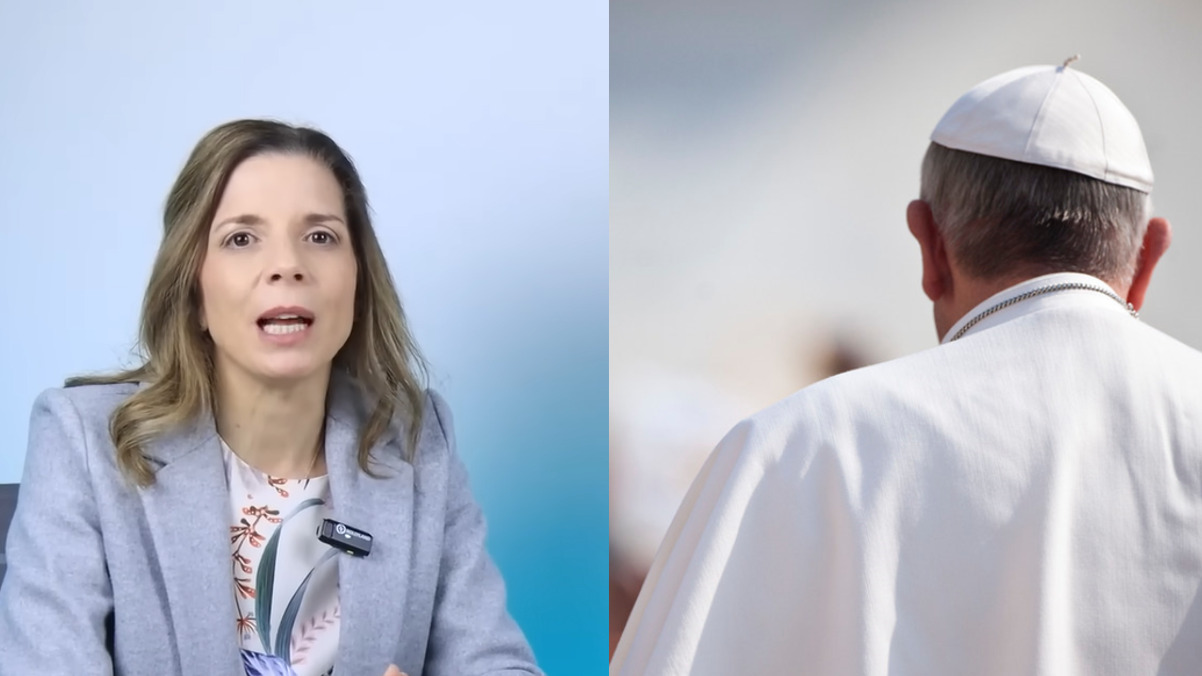
What makes the Sodalitium so relevant?
Finally, there is the issue of the mind-blogging developments in France where the current head of government, François Bayrou, confronts the many loose ends he left when he was the French minister of Education in the latter years of the 20th century and where his own offspring were students at the Catholic school of Our Lady of Bétharram.
In an unexpected turn of events Bayrou’s daughter, who legally changed her name to Hélène Perlant, as to avoid the consequences of being identified as Bayrou’s relative, first seemed to offer him some relief when she said that she never told her father about the abuse she suffered while attending an activity at Bétharram.
Many even thought that she was saying that as to help her father, and yet, a bit later, she also acknowledged that she was aware of her father’s meeting with now former judge Christian Mirande, who recently stated before a congressional committee that he informed Bayrou about what was happening at the school.
English Edition
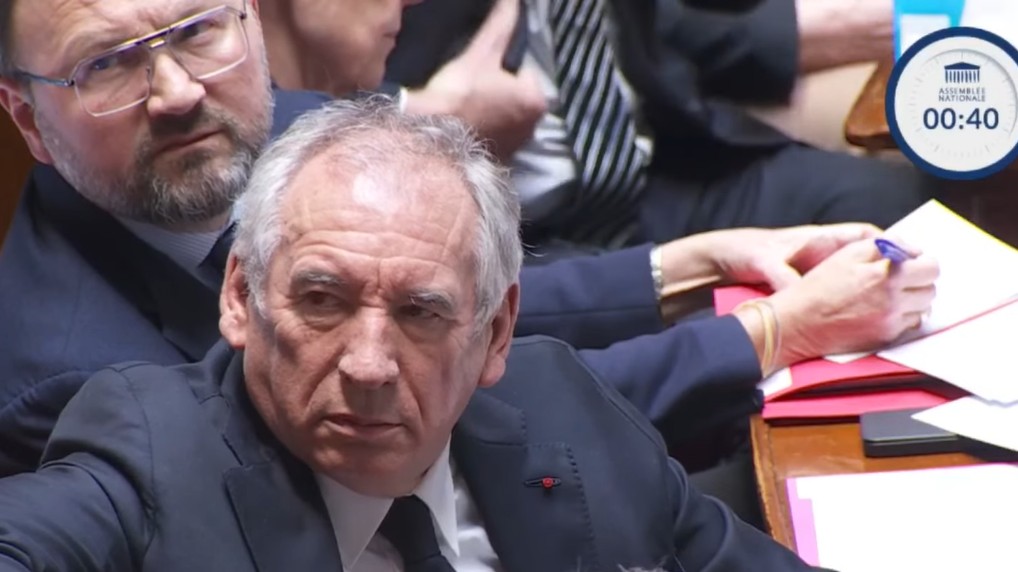
Bayrou, French Prime Minister, to testify on sexual abuse
That was the subject of the story linked before this paragraph. In his testimony to the committee of the French National Assembly dealing with this issue, Mirande, and a now retired policeman said that both warned then national minister of Education about the abuse happening at Bétharram. And not only them. There is at least one more testimony from a former professor at the Catholic school saying she warned the current Prime Minister.
France is especially significant to understand the clergy sexual abuse crisis because many critics of the Catholic Church see, up until today, the secularism or Laïcité laws of France as the example to follow when drawing the lines between Church and State.
The “Lay State” paradox
Fact is, however, that as it happened in Mexico, where the local political elite also brags a lot about the so-called “lay State”, said configuration of the Church-State relationship has been useless for survivors of clergy sexual abuse crisis in Mexico, as they confront similar and even worse conditions as survivors in countries where there is no separation, as in Peru.
What is worse, there is evidence that the strict laws in Mexico, strict at least in paper, actually helped Marcial Maciel to sustain the false narrative of a prosecuted Church and of him as a victim of some sort of systematic attacks from the Mexican, secularist, left.
Going back to the issue of the lose ends left by Pope Francis, this Monday April 28th the Cardinals attending the so-called “General Congregations” set the date to start the Conclave to Wednesday, May 7th.
English Edition
Pope Francis forces out of office 30 bishops in two years
Previous installments of this series, have both summarized the accomplishments of his papacy, as described in the story linked above, about the number of bishops forced out of office, but also have stressed the limits and contradictions of his papacy, as the story linked below tells.

English Edition
From blunder to blunder: Roman Catholicism and sexuality
His, as any other papacy or term of office of a Chief of State, included some improvements, mostly his decision to suppress the Sodalitium, and shortcomings as in the case of how Tutela Minorum let the Mexican conference of Catholic Bishops, the so-called CEM pretend that they are in compliance with his request of having a commission to prevent clergy sexual abuse in each diocese of the country.

English Edition
The Catholic Church’s report on clergy sexual abuse
Next week’s installment of this series will be dealing in depth with the 2025 conclave and the kind of issues that will shape it, but it is possible to say at this point that there is a chance that this will be a relatively short conclave.
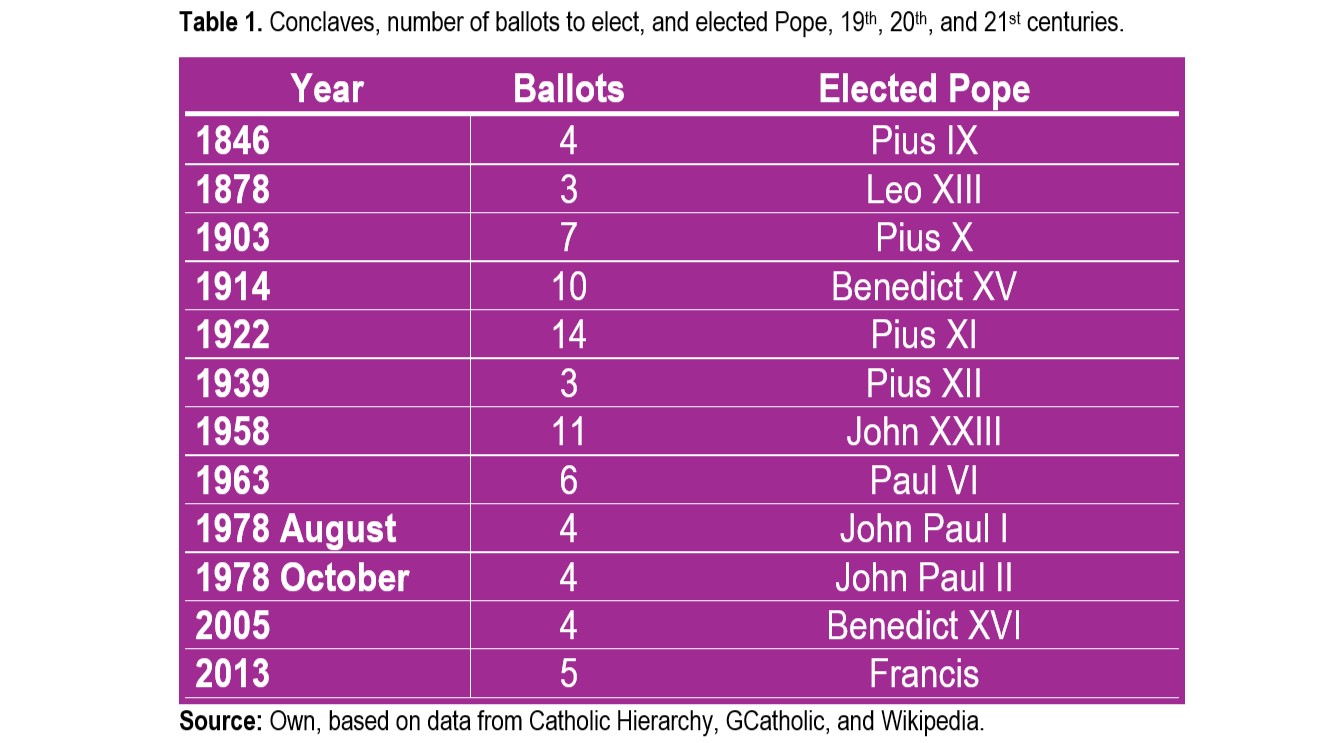
If the trend from the last six conclaves remains, it is possible to assume that a new Pope will be elected by the fourth or fifth round, depending on when they have their first vote, in the first or second day of ballots, it would mean having a new Pope by the third or fourth day of the conclave.
Contentious conclaves
But as Table 1 proves, there have been very contentious conclaves, 1922 the most notable of those in the sample, going all the way to the 14th ballot. If that is the case, then we would be waiting for more than a week, as it is customary to limit the number of ballots per day to a maximum of two in the morning and another two in the afternoon.
The rules dealing with the election of a new Pope consider that scenario. Sections 74-5 of Universi Dominici Gregis, state:
- 74. In the event that the Cardinal electors find it difficult to agree on the person to be elected, after balloting has been carried out for three days in the form described above (in Nos. 62ff) without result, voting is to be suspended for a maximum of one day in order to allow a pause for prayer, informal discussion among the voters, and a brief spiritual exhortation given by the senior Cardinal in the Order of Deacons. Voting is then resumed in the usual manner, and after seven ballots, if the election has not taken place, there is another pause for prayer, discussion and an exhortation given by the senior Cardinal in the Order of Priests. Another series of seven ballots is then held and, if there has still been no election, this is followed by a further pause for prayer, discussion and an exhortation given by the senior Cardinal in the Order of Bishops. Voting is then resumed in the usual manner and, unless the election occurs, it is to continue for seven ballots.
- 75.n If the balloting mentioned in Nos. 72, 73 and 74 of the aforementioned Constitution does not result in an election, one day shall be dedicated to prayer, reflection and dialogue; in the successive balloting, observing the order established in No. 74 of the same Constitution, only the two names which received the greatest number of votes in the previous scrutiny, will have passive voice. There can be no waiving of the requirement that, in these ballots too, for a valid election to take place there must be a clear majority of at least two thirds of the votes of the Cardinals present and voting. In these ballots the two names having passive voice do not have active voice.
Next week’s installment will go over more details of the election that requires a minimum of at least 90 votes for a candidate to comply with the two thirds majority rule that has been customary for the Church.
Loose ends
However, despite the apparent ease with which the Conclave seems to be happening, there is the issue of the loose ends left by Pope Francis. The most damaging of those lose ends is the challenge poised by Angelo Becciu to the now deceased Pope’s decision to punish him for the mismanagement of funds in his care.
It is impossible to go over the reasons why Francis decided to exclude Becciu. Suffice to say at this point that the Church’s handling of monies and funds is not precisely transparent or stellar.
Becciu used the banking accounts of one of his relatives to perform some kind of “creative accounting,” to put it nicely, that ended up biting him and the Holy See back. That was the source of many attacks on Francis from the Italian far-right unhappy with his support for the migrants trying to enter the European Union.
The civil trial in Italian courts was not as conclusive as required for a case like this, so Becciu got a less than expected sentence that is in the never-ending nightmare of appeals and that it is hard to even imagine how or when will end.

Becciu went as far as to threat Francis to sue him for having hurt his chances to become Pope, and even if for some unknown reason Becciu actually avoided that path, now he wants to be included again in the College of Cardinals.
Since it used to be that nobody ever challenged a Pope, much less a Cardinal who owed his career to said Pope, there is an actual void in the rules.
It is true that section 36 of Universi Dominici Gregis expressly prevents the reincorporation to the College of Cardinals of a former member of that body before a Conclave, Becciu still shows up as Cardinal in the Dashboard for the College of Cardinals, set up by the Holy See, as the image after this paragraph proves.

It is hard to figure out what will happen with Becciu’s case. For the time being it will be up to Cardinal Giovanni Battista Re, the Dean of the College of Cardinals, and Cardinal Kevin Farrell, the Camerlengo or Chamberlain of the Church, to deal with Becciu’s claims, but the very fact that he is willing to challenge Pope Francis’s decision after his death should reveal an aspect of the power struggles hidden behind the many layers of ecclesiastical robes used by Becciu and many other members of the College of Cardinals.
His situation is similar in all respects to that of the now emeritus archbishop of Lima and member of the Opus Dei, Juan Luis Cipriani Thorne, who recently decided to dismiss the rather weak, inconsistent, and ultimately inconsequential “punishment” issued by Francis himself for his role in the sexual abuse of male before John Paul II appointed him archbishop of the Peruvian capital city.
The inconsistency in how the Church deals with these and other cases is not only an issue to consider when figuring out Francis’s legacy. It is similar to John Paul II’s deaf attitude when dealing with Marcial Maciel’s abuses or when extending his protection to Bernard Law, the former archbishop of Boston, and similar in all respect to what Benedict XVI did with other predators, as with Theodore McCarrick, a case considered in detail in the installment linked after this paragraph.

English Edition
Theodore McCarrick: Dead dogs don‘t bite?
In essence, the upcoming conclave arrives at a pivotal moment for the Catholic Church, burdened by the unresolved legacies of several of its previous pontiffs. The confluence of the clergy sexual abuse crisis, the complex interplay between Church and State in specific countries such as France, Mexico, or Brazil, and the internal power struggles within the Vatican create a challenging landscape for the Cardinals.
The election of Pope Francis’s successor is relevant for the Church electing its new leader, but also reverberates across the global stage, far beyond the Vatican walls, as the Catholic Church is able to challenge the short-sighted understanding of leaders too obsessed with their own political goals.
In his last days in office, Francis issued a letter warning the U.S. Conference of Catholic Bishops (see the story linked after this paragraph) dealing with themes and problems going beyond Donald Trump’s systematic attack on migrant communities, forcing us to question our very understanding of what is human.

English Edition
Pope Francis decries US migration policy under Trump
The decisions made during this conclave will shape the Catholic Church’s response to these critical issues, influencing its credibility and relevance in a rapidly changing world.
Even if the Cardinals will deliberate in a secluded location, the world will be watching. They must be aware that the outcome will have profound implications for millions of Catholics and for broader exchanges on faith, power, and accountability.
The path forward remains uncertain, but one thing is clear: the new Pope will inherit a Church facing immense challenges demanding decisive, transformative, but inclusive leadership.
