
Rodolfo Soriano-Núñez Jueves, 28 de Agosto del 2025
Silvia was close to her Church, so much she tried to become a nun and was willing to devote countless hours as volunteer in her parish.
Silvia's trust in the Catholic Church was shattered by a priest who, after trying to abuse her, sought to discredit her.
By Rodolfo Soriano-Núñez
Silvia, the main character of today’s story, still identifies herself as a woman of faith, not Catholic anymore, but a woman of faith nonetheless who was subject at a very early age to the contradictory admonition of a priest “warning” her about not letting anybody touch her privates, while he himself forcing his fingers in Silvia’s genitalia during confession.
The priest behind the first abuse on Silvia still receives praise over Mexican social media. Javier Ochoa Vaca’s name appears as some sort of local celebrity, one deserving praise and accolades in social media postings of people with ties to the township of Yurécuaro, Michoacán, where he spent the last years of his life.
Not from Silvia. For her the experience was traumatic to say the least. When going over her case during an interview over WhatsApp, she stresses repeatedly the pain the priest’s fingers inflicted on her privates. How, for many days, weeks, she had to deal with the conflicting ideas of him warning her about not letting anybody do what he actually did, not to mention the physical pain.
“Back then I was unaware of what had happened to me that day, when Father Ochoa Vaca hurt me. I can only remember it was very painful. I had an intense pain over several days. It hurt me when urinating when I had to clean myself.
“I was unable to understand it had sexual abuse. It was only when I started to hear about other cases, around the same time, that I figured out what had happened to me.
“To be honest, I had never spoken. It was only after talking with my own older sister that she told she had gone through a similar experience when she was, as I was at the time of the attack, 7, although for her was harder as Ochoa Vaca would stare at her breast.
“Then I spoke about it with my other sister and the situation was pretty much the same, when she was 7, the same Ochoa Vaca would find a excuse to touch her torso, her breasts.
“Now, the three of us over 40, share our experiences and realize that we were unable to talk about the issue, not even us, three sisters of similar age. We kept it to ourselves, silent".
Leaving the Church
That is why today’s story, neither recent nor unique, is relevant. It is one of the many cases going unreported even by the media over many decades, and probably centuries.
Despite Silvia’s upbringing, and a period of intense participation in the Church, leading her to join a religious order, now identifies herself as a former Catholic, a Christian according to her, and twice victim of clergy sexual abuse.
First, while she was still a little girl, right after her First Communion, back in 1992, and later when she was able to find some joy in the experience of a shared faith in a parish at the diocese of San Juan de los Lagos, in the Western state of Jalisco, Mexico, from 1999 and the during the early Aughts.
Ochoa Vaca died three years after the attack on Silvia, back in 1995. Even before the era of Internet there was an overabundance of good will towards him and his memory. In 2001 a local magazine, still printed in paper, ran one of his poems with a short bio and the cover using a picture of him in business suit, probably from the late 1980s or early 1990s, as it was common in Mexico up until the mid-1990s when the restrictions to the use of clerical garments were abolished in Mexico.
The poem is the run-of-the-mill exalting the virtues of life in small communities of the Mexican, deeply Catholic, Bajío (Lowlands) where Mexican Catholicism survived the years of deaf toned conflict with the government that led to the 1926-9 Civil War usually called in Mexico the Cristiada or Cristero War.
The poem mixes and matches easy rhymes with references to the natural beauty of the surroundings, so it is a local nationalists’ favorite, even if they are not devout Catholics, as it exalts Mexico, local landmarks, and the love for the homeland.
But also, there is a stanza where the priest praises the beauty of females from Yurécuaro, perhaps providing a hint at his inner thoughts.
A more recent book, printed in paper and as a PDF in 2016 compiles the very same poem, with similar local poetry about the same town of Yurécuaro, in the state of Michoacán. It is available in Spanish here.
The same poem appears over and over in the Facebook postings of Mexicans living on both sides of the U.S.-Mexico border, whether when they go back to Yurécuaro, or when the nostalgia of their inability to go back, for whatever reason, leads to the kind of anguish that only a posting over social media ease.
If one follows the messages celebrating Ochoa Vaca priesthood it is clear why Silvia would rather remain anonymous, one of many female survivors of clergy sexual abuse well aware of the kind of backlash they or their relatives will face in the small towns or Mexico or in the many public or private Facebook groups where people with some association with Yurécuaro, the diocese of Zamora, or the state of Michoacán at large sustain.
There are postings going back five or ten years talking about how he presided over their weddings or how he baptized their sons or daughters, or even how he presided over the funerals of a loved one.
Given the fact that Ochoa Vaca, the first priest who attacked her is already dead, and she has a new life, but her family still lives in the vicinity of San Juan de los Lagos, she decided to remain anonymous, identified only as Silvia, a pseudonym.
Breaking the silence
She belongs to a relatively “new” category of female survivors of clergy sexual abuse who are coming forward to tell the story about that happened to them in the wake of numerous cases going public, but with little or no chances of evolving into a judicial case, whether because of the legal frameworks making such transition almost impossible, or because they are unwilling through the ordeal of a formal attempt at achieving a measure of justice.
This “new” class of survivors is only new in name. They have existed probably for many centuries but have chosen to remain silent. They do so because of the hefty consequences derived from going public against Catholic priests, and even more so when they try to do it in a formal setting.
Some members of this “new” category are nuns or former nuns, coming forward with stories about how out of loyalty for their Church or because they are forced to by the female superiors of their congregations, they keep quiet for years.
Early this year, as part of this series, Los Angeles Press published a book titled Breaking the silence, about the heartbreaking experience of a Mexican nun originally born in Chiapas who was subject to repeated instance of abuse in that state and near Mexico City. The book can be downloaded over the story linked after this paragraph.
This is not an exaggeration. It is possible to assert that cases such as today’s have been happening over many centuries, because there are the records of the Holy Inquisition.
Whether at Mexico City, Lima, Peru or Seville, Spain, one finds a three-centuries long registry of abuse against females, laypersons and religious or sisters, without actual punishment for the perpetrators, as is today’s case.
Silvia holds her breath and then goes into the narrative of her second experience with clergy sexual abuse.
“Even if that experience hurt me a lot, over time, I moved from the place where I used to live in Michoacán, to La Ribera, in Jalisco. Most of my relatives on my father’s side are from there”.
Silvia goes over the deeply Catholic identity of her relatives at La Ribera, a township that was already then part of the diocese of San Juan de Los Lagos. La Ribera and Yurécuaro are twin towns in rural Mexico separated by the boundary separating, simultaneously the states of Jalisco, where La Ribera sits, and Michoacán, where Yurécuaro is located. The boundaries are pretty much the same between the diocese of Zamora (Michoacán), and that of San Juan de los Lagos (Jalisco), as the map after this paragraph shows.
Despite being named after Saint John the Baptist, who is the patron of the diocese, the main religious devotion in the region is a small image, little less than 13 inches or 34 centimeters high of Mary, mother of Jesus.
The Basilica at San Juan de Los Lagos is the second most visited Marian shrine after that of Our Lady of Guadalupe, in Mexico City. Together, both basilicas, mobilize over 21 million visitors per year, according to data from 2009, the most recent available, compiled by the Tourism Bureau of Jalisco for a white paper (content in Spanish) to promote that type of tourism in San Juan de los Lagos.
John Paul II’s visit to San Juan de los Lagos, back in 1990, during his second pastoral tour of Mexico boosted the devotion, as it legitimized the claims of martyrdom for local clergy and laypersons who would be canonized ten years later by him at Saint Peter’s square in Rome.
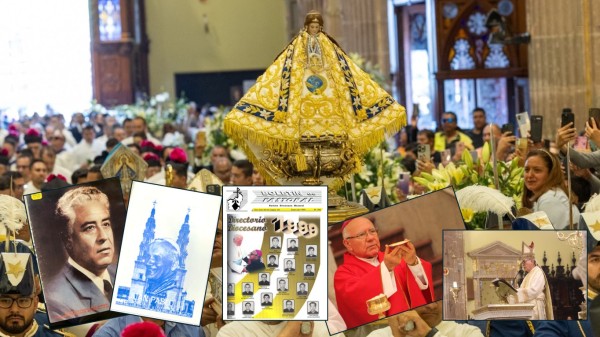
One of the 25 so-called, Cristero Martyrs was Pedro Esqueda Ramírez, a native of San Juan de los Lagos. His image and some of the other 24 martyrs frequently appear in Catholic media ever since, as the images from two different issues of the diocesan bulletin prove.
Silvia’s family was involved, at the time, in selling Catholic religious items there.
Faith revival
She recalls how even if they were happy to have her around, as part of the many familial firms in that kind of trade, and they were eager to have her join the religious activities, she remained hesitant to attend regular services, as she was still scarred and confused because of her experience as a young girl.
“I was very afraid,” she remembers, “I would attend the services, but I would never confess, and I would be always near my closest friends at the time. I was very afraid but, step by step, I was able to see the priests there were very nice persons, or so them seem to me. And the seminarians even more so. That is when I found myself at ease”.
“I joined a youth group, and I went to missions with religious sisters. I was very happy to do so. That was when I was between 13 and 14. Before my 15th birthday, I decided to join the Poor Clares. I went to a house near Toluca. And I was happy. I see myself as deeply religious, I have always believed there is a Supreme Being”.
Silvia does not mention it, but that happened precisely at the time the Mexican Lowlands were abuzz with the religious fervor, a faith revival of sorts, stemming from the canonization of the 25 Cristero Martyrs.
Silvia was not a good fit for the strict and ever suspicious Poor Clares, there were issues there with their understanding of discipline, but she seems to keep at least some good memories of her time at the so-called Aspirancy, a community for the young girls who want to figure out, or discern in Church parlance, if religious life is for them.
After leaving the Poor Clares Aspirancy Community near Toluca, when Silvia was already 17, she went back to La Ribera. It was already 2002 and her mother had died recently so she was alone and vulnerable. Even if her father’s family claimed Catholic identities and allegiances, he was the archetypical Mexican father: absent and distant, for practical purposes, she was on her own.
At that point she rejoined a local youth group where she would do lots of volunteer, unpaid work for the Church. Among her duties was providing some assistance to a then relatively young and recently ordained priest, Jaime Antonio Gutiérrez Muñoz.
Losing your religion
Even if the interactions seemed to be nice and respectful, there were plenty of innuendos. The one that stuck in Silvia’s memory is the many times he, a young priest, would ask her, an underage teenager volunteering at the parish youth group, if she “had already lost to her boyfriend”.
What was lost would never be fully stated. It was merely implied, as it is common in the purposely inaccurate Spanish in Mexico when the issue is sexuality. She would deflect the innuendos, telling the priest she had no boyfriend as she was “not old enough”.
Silvia goes over the memories of the kind of volunteering she was doing there. While she did, she remembers how she would do her best to assume it was merely a joke, as she would be at the parish frequently.
“I would help him and other priests, as in the case of José Luis Tapia Nárvaez, to put together a newspaper for the parish. I would do some office work for them. Attending phones, taking requests for intentions over the Masses, balancing the books, or programming appointments with parishioners, and even counting the money collected over the so-called poor or alms boxes.
Silvia recalls how the intensity of the “jokes” would increase over time, making her increasingly uncomfortable with them. At some point, the innuendo went from a vague question about “losing it” to a proposition of sorts:
“If you have not lost it with your boyfriend, you can lose to me in any beach where you would want to go. It was then when it got scary. So I went to father Beto (short for either Alberto or Roberto in Mexican Spanish), and he told me that I should lock myself in at the office where I used to do the volunteer work for them”.
Her recollection of her life at the time, more than 20 years ago, continues: “one day, after Mass, Father Tapia Nárvaez, kissed me in the forefront. It was odd, and even more so, because he rubbed my shoulders in a weird manner that I felt as if he was being compassionate with me, as if saying ‘Poor little you!’
“It was a few days after my mother’s death. Or that is what I thought at the time. But it was really weird, so I had to be aware of both father Jaime Antonio Gutiérrez Muñoz, and Father Tapia Nárvaez”.
According to the available information, Gutiérrez Muñoz registered as date of birth February 3, 1968, so he was a bit over 30 when this was happening. He was ordained in May 1998.
At his turn, Tapia Narváez, was coming back from Cintalapa, in the Southern state of Chiapas. It has been impossible to know what the reasons behind his time in Chiapas were. Cintalapa is part of what was at the time the diocese, now archdiocese, of Tuxtla Gutiérrez. He appears in the diocesan directories as born on September 26, 1963, so at the time of the attacks on Silvia he was over 35. He was ordained in May 1993.
The data for both priests, as found on pages 27 and 10 respectively, was retrieved from the 1999 diocesan directory. A picture of the cover appears after this paragraph.
“Another day, Gutiérrez Muñoz entered the office I was working at. Allegedly he was there to give me the paperwork for some upcoming marriages, the so-called Marriage Banns, as to add a small notice at the newspaper”.
And, then and there, again: “If you have not lost to your boyfriend, you could lose to me… And right now, since we are alone…”
Your word against a priest’s
Then, Silvia recalls, “he jumped over me. He tried to force himself over me. He grabbed my body, and he ripped parts of my clothing. I left the place extremely scared, barely able to grab a sweater I had there as to cover the blouse he had ripped apart while trying to grab me”.
“The only thing I was able to do was to run over the mayor’s office. A surrogate for the mayor was there. I told him what just happened to me with the priest, and he immediately said he was unable to do anything.
“He said, instead, that it would be my word against that of the priest and that I was surely telling a lie, because I was unable to file a report, since I was an underage girl and there was no adult accompanying me”.
Silvia goes over how this surrogate of the mayor would treat her as if she was a prostitute, despite the fact she asked for his help while he was as the mayor’s office carrying some authority as a delegate, a surrogate there. He would claim, later, publicly, that Silvia was promiscuous, having simultaneous relationships with several males, when she had not relation at all until later.
At this point, Silvia’s tone becomes somber, and it is impossible not to think about how her experience resonates with that of many other survivors of clergy sexual abuse who are revictimized by complicit government officials unwilling to do what it takes in these cases.
“Since then, I got it. I learnt nobody would ever believe me. And that is why I would never say anything about my experience. The priest who attacked me, Jaime Antonio Gutiérrez Muñoz, twisted the whole thing as to discredit me. He claimed I was stealing money from a Independence Festivities pageant whose profits benefit the parish.
“I was at the time the helping one of the young females aiming at becoming the Queen of the festivities. She was famous and well known there, as they had some musical band.
“When Gutiérrez Muñoz said that about me, the mother of this young female refuted the priest, stressing how it was her who was in charge of the boxes where that money was collected, and how I would never carry those boxes”.
Gutiérrez Muñoz was trying to discredit her, depicting her as stealing money that was earmarked for the local parish, turning Silvia into an enemy of the parish at large.
Blame game
Priest Gutiérrez Muñoz seemed to need an excuse to explain why Silvia was no longer willing to volunteer at the Parish, doing office work since 1999 when she went back to her home after ending her “discernment” period as an aspirant with the Poor Clares.
Years later, in 2007, she engaged in a relationship with a male, but she was hesitant about going over the formalities of Catholic marriage. Her in-laws, however, were unwilling to back down, so she agreed to having a Catholic wedding at to prevent more conflict with her husband.
The pressure increased when she finally accepted to baptize her daughter. She accepted but set restrictions on the confession. She asked her husband to be near her and not to use the confession box. Her husband was already aware of some aspects of the situation, not the whole story, as she it brings pain and suffering to her, but he supported her.
It would be in 2018 when after going over her own fraught relationship with Catholicism that she decided to leave the Church and join another denomination.
The first instance of abuse, when Silvia was a young girl, aged 7, happened at the diocese of Zamora, during the tenure of the late bishop José Esaúl Robles Domínguez (1974-1993).
The second instance of abuse occurred at the diocese of San Juan de los Lagos, Jalisco during Javier Navarro Rodríguez’s (1999-2007) tenure there. He is the current bishop of Zamora, Michoacán.
As of August 27, 2025, Navarro is one of eight Mexican bishops over 75 years old who are still in office. Two of them are the Cardinals and archbishops of Guadalajara, Cardinal José Francisco Robles Ortega. The other is the archbishop of Mexico City, Carlos Aguiar Retes.
Among the other six, one is Navarro Rodríguez, the current head of the diocese of Zamora, in the Western state of Michoacán. Born on October 27, 1949, so he will become 76 in little less than two months.
Navarro is a key figure of the Mexican Catholic Church. He was promoted to bishop of San Juan de los Lagos in 1999, after a seven-year stint as auxiliary of Guadalajara, Jalisco, where he was promoted first by Juan Jesús Posadas Ocampo, a now deceased Cardinal who died in what the Mexican government ruled an execution by confusion in May 1993 at the parking lot of the Airport of Guadalajara.
For a little while he was perceived as a potential heir to that see, the crown of the jewel of the global Catholic Church, as the seminary there boasts with being the one with the largest student population (541 students) according to the Annuario Pontificio as reported by GCatholic.
However, it would be Juan Sandoval Iñíguez, then bishop of Ciudad Juárez, Chihuahua, who got the preference of Girolamo Prigione, the then nuncio to Mexico.
Navarro Rodríguez remained an influential figure under Sandoval Iñíguez’s tenure in Guadalajara, when San Juan de Los Lagos, one of Guadalajara’s suffragan dioceses was available, he got the promotion there, and then to a prime destination for Mexican bishops: Zamora.
A previous installment of this series dealing with the cases in Ciudad Juárez, where Juan Sandoval Íñiguez was bishop before assuming the Archdiocese of Guadalajara, dealt partially with Navarro Rodríguez, the current bishop of Zamora and former of San Juan de los Lagos. That story is linked below this paragraph, but is available only in Spanish.