
Rodolfo Soriano-Núñez Lunes, 13 de Abril del 2026
In a swift move, a Mexican diocese suppressed an order founded at the height of the anti-abortion culture wars. Was abuse the culprit?
However, when Mexican dioceses have to actually deal with the effects of sexual abuse, their response is lethargic.
By Rodolfo Soriano-Núñez
Easter’s week came with revelations about alleged threats, reported as “warnings” of kidnapping the sitting Pope issued by the Trump administration and news about the sudden end of an order-like group in Southern Mexico, while in Northern Mexico there was a reminder of how painful it is for victims to deal with the Catholic hierarchy’s disdain. It also brought hints about potential reparations to victims of the Peruvian Sodalitium.
A few hours after news emerged of how, back in January, Cardinal Christophe Pierre, the former nuncio to the United States, got a warning from the Trump administration about its will to kidnap the sitting Pope, in Mexico the archdiocese of Tuxtla Gutiérrez made itself a favor by suppressing a local religious organization, an order of sorts, with a known record or sectarian behavior.
José Francisco González’s decision to suppress the Religious Family of the Immaculate Heart and the Holy Mercy, known either by their Spanish-language acronym, FRICYDIM, or simply as “immaculate heart,” is hardly a global-scale move, but it could be a first sign of the acknowledgment of how dangerous it is for the Catholic Church itself to allow or bet on growth fostered by that kind of behavior.
Whether or not Elbridge Colby, the Trump administration undersecretary of Defense for Policy, issued an explicit threat to Cardinal Christophe Pierre is irrelevant. The fact that Trump appointed Bryan Burch, a former leader of Catholic Vote, as ambassador to the Vatican was on its own a sign of how the U.S. Catholic far-right was willing to challenge and “house-break,” if required, the Pope himself.
House-breaking the Pope is what we know now Steve Bannon was trying to do with Pope Francis, when using his network of far-right, identitarian and populist European politicians to demean, attack, and isolate as much as possible Pope Bergoglio, an endeavor mirroring Jeffrey Epstein’s own tactics when dealing with underage females to force them into his service.
In that respect, “house-breaking” Leo XIV would only continue what they have been doing for the last 20 years or so. Catholic Vote and adjacent organizations—claiming to represent the whole Church even if there is no actual authorization to do so, at least not as stated by canon 216 of the Code of Canon Law.
That is a playbook they have been following for the last three decades or so, weaponizing venerable Catholic organizations such as the Knights of Columbus or creating new ones to legitimize their top-down, clerical, and elite-driven understanding of Catholicism, such as the Napa Institute.
They were not alone. The cohorts of bishops promoted by John Paul II toward the end of his first decade as pontiff, and even more so by Benedict XVI, were notable for the way they narrowed as much as possible Catholic theology. These bishops were increasingly “culture warriors” with an increasingly narrow understanding of Catholic doctrine, centered almost exclusively on abortion.
Culture warriors
One of the most radical “culture warriors” to become bishop was Joseph Strickland. He is the former bishop of Tyler, Texas, who was forced out of office by Pope Francis in late October 2023, as the story linked after this paragraph told at the time, after a series of confrontations with the Argentine Pontiff.
It is unclear if the warning Colby gave Pierre was as explicit as told by the Free Press, but one should keep in mind how similar threats against the Catholic Church were issued at different points in time by Steve Bannon and other wealthy Catholics when Pope Francis was alive and more intensely around the 2025 Conclave.
The story linked after this paragraph, from May 19, 2025, went over how Bannon and other self-proclaimed Catholics in the MAGA coalition delegitimized Robert Prevost election as Pope as “more rigged than the (U.S.) 2020 election.”
As with the dubious claims made by MAGA in the United States, Bannon offered no evidence of any rigging of the conclave. As he does to mobilize the MAGA base for a third Trump Presidency, Bannon’s sole claim to legitimize his views was that, somehow, he was able to see what other Catholics were not, just like other sectarian groups, Catholic or otherwise, do when calling themselves special, chosen, preferred.
That piece also summarizes information published before the 2025 Conclave where wealthy Catholics said they were willing to bankroll a new Pope if the new leader of the Catholic Church was willing to follow their understanding of Catholic doctrine.
In that respect, even if Free Press had published an outright fabrication, a click-and-bait coy, and it could have been, there is a long record of attempts by the U.S. “Catholic” far-right to domesticate what they perceive as their global leaders going astray.
A “hostage, kidnapped pope” is not fantasy. It happened during the so-called Avignon Papacy, and in 1870 Pius IX branded himself the “prisoner in the Vatican,” turning confinement into an argument for sovereignty and autonomy.
This is an argument that echoes in the Trump administration’s desperate attempts at claiming a religious legitimacy that, at least for the time being, Leo XIV has been unwilling to give him, although Catholic figures such as Robert Barron sprinkle Latin and lace over the effort, while a small army of non‑Catholic religious leaders was willing to “lay hands” on Trump as a sign of blessing.
News from the Mexican South
It is clear that what happened in Chiapas has little or nothing to do with whether Cardinal Pierre, the former nuncio to the United States and before that to Mexico, was warned about the United States kidnapping the first American Pope, but the underlying theme in both issues is how far sect-like organizations are willing to go when trying to enforce their own understanding of doctrine and whether or not the Catholic Church under Leo XIV is willing to face that fact.
More so, as the decision in Chiapas was not made by a relatively young, rookie, bishop promoted by Francis as a message to older prelates. The decision comes from a rather conservative bishop promoted by Benedict XVI back in 2008.
Moreover, Jose Francisco González came to the capital of Chiapas after an 11-year stint as bishop of Campeche, a diocese marred by similar issues with allegedly “strict” religious orders that ultimately left a trail of scandals and disagreements with Ramón Castro, the current bishop of Cuernavaca and president of Mexican Conference of Catholic Bishops.
Also, one must take into consideration González lineage. He is not the kind of bishop who would, on his own volition, go against this kind of predatory and sectarian orders. He became bishop as auxiliary in Guadalajara.
He owes his promotion to bishop to Juan Sandoval Íñiguez who, at the time of González’s consecration as auxiliary, was already above 75, “playing overtime,” during Benedict XVI’s pontificate.
González is hardly a bishop one would think would be willing to pull the trigger on a relatively new foundation of a conservative movement just because. Even if there are not enough testimonies of what actually happened that prompted González’s curia into such decision, it is clear that there are the tell-tale signs of predatory and sectarian behavior, and that for some reason González suppressed the movement.
What is worse, given what we have learnt so far about the clergy sexual abuse at large and at that diocese, the very silence, the fact that the parties involved are doing their best to keep quiet is already a tell sign of “issues” to say the least.
More so as González got the appointment after a relatively long period of 459 days, from November 23, 2023 until February 26, 2025, when the archdiocese remained vacant, under an apostolic administrator, who was not the sole auxiliary bishop of the diocese, but the bishop of the neighboring diocese of San Cristóbal de Las Casas, Rodrigo Aguilar Martínez.
Apostolic administrators
Early this year, this series looked at how Rome has been increasingly using, over the last 20 years or so, the figure of the apostolic administrator to deal with dioceses under severe stress, where there is no possible swift appointment of a successor, where there is the need to assess what have been happening in that religious district.
One only needs to look at what happened also last week at the diocese of Matehuala, San Luis Potosí, where Pope Leo XIV appointed as apostolic administrator the current archbishop of that state’s capital, Jorge Alberto Cavazos Arizpe, one of the Mexican “specialists” frequently deployed to other dioceses as apostolic administrator, as the story linked above proved before this appointment.
Cavazos Arizpe’s appointment comes after the former bishop there, Margarito Salazar Cárdenas, was sent to Tampico to fill a 10-month long vacancy. That situation was the byproduct, at its turn, of José Armando Álvarez Cano’s appointment as archbishop coadjutor of Morelia, Michoacán, which is already a sign that something was not going well in that city in Western Mexico.
For comparison’s sake, the diocese of Saltillo, in the Northern state of Coahuila, solved the succession of bishop Raúl Vera López in less than 3 months. Pope Francis accepted his resignation on November 21, 2020. That day he appointed, Hilario González García, who took over on January 29, 2021.
When archbishop Fabio Martínez Casillas died in 2023, he was already 73, but he left clergy sexual abuse cases unsolved, only partially addressed which, for practical purposes remain open for archbishop González, since the issue of reparations for at least one of the victims remain unaddressed.
That case, dealing with repeated instances of abuse of a Mexican nun originally born in Tuxtla Gutiérrez, became the subject of a subseries of three installments of this series and eventually was turned into a bilingual book that can be downloaded in the story linked after this paragraph.
It is unclear at this point if the now suppressed order of the Immaculate Heart has been named by potential victims of clergy sexual abuse, and the silence with which both the archdiocese and the order itself treat the issue is less than helpful, but it is not hard to imagine that one of the reasons behind the sudden death of this order is abuse.
But even if one was willing to put those issues aside, it would be rather hard to imagine González suppressing at the speed of light, a conservative, apparently rigorous order, on a whim, as the foundation of the Immaculate Heart dates back to 2012, when Tuxtla Gutiérrez was under Rogelio Cabrera López’s leadership. He is the current archbishop of Monterrey, and twice president 2018-24 of the aforementioned conference of bishops.
In that respect it is even harder to imagine González acting on his own without, on the one hand letting Cabrera now what was the current situation of the order, small enough to be limited to the territory of the archdiocese of Tuxtla Gutiérrez. More so, as the internal probe took less than two months since the first symptoms that something was not moving according to expectations.
First symptoms
One of such first symptoms emerged when the very active Facebook account of the organization announced, back on July 24, 2025, that they would enter into a period of “silence and prayer,” as the card linked after this paragraph states in Spanish.
After that, in January, a series of messages on that account claimed that there were IA-generated videos using the organization’s name to attack archbishop González and the Catholic Church at large.
On March 18, 2026, the archdiocesan chancellor, Luis Eduardo Palomo Beltrán, issued a one-page statement, see below, where he lets know that Rome, through the Prefect of the Dicastery for Institutes of Consecrated Life and Societies of Apostolic Life, sister Simona Brambilla, asked archbishop González to meet with the leaders of the religious order.
Oddly enough, Palomo Beltrán never mentions Brambilla by name, probably because male clergy are still shocked at Pope Francis’s decision to appoint her as head of that Dicastery and probably also by Pope Prevost’s decision to confirm her with the rest of the heads of dicasteries and other Vatican entities little more than a year ago, on May 9, 2025, the next day of his election.
González meeting with the order’s leaders happened on March 13. Again, in a swift move, three days later, on the 16, the archbishop had already decided to restrict the order’s ministry to private activities and to forbade the priests associated to it from celebrating mass or other sacraments in public.
The same day, the leaders of the order said they were obedient to the archbishop, as the statement linked after this paragraph, available only in Spanish, proves.
Ultimately, less than one month later, on April 7, 2026, archbishop González issued the decree suppressing the order, as the post over Facebook linked after this paragraph proves.
Foul play?
It must be noted, however, that as in any resolution at the diocesan level, the suppression of this organization will go through Rome. On Wednesday 8, the leaders of the group issued a new statement. Even if the seem willing to comply, they are hardly at ease with González’s decree, so, they will go Rome to appeal the process.
They will do so despite the fact that the statement and what lay persons close to the archbishop are saying over social media is that there are fighting a lost cause. Nobody should be surprised they are fighting out, challenging the archbishop’s decision as ultimately, any decision made by a bishop on these matters can be the subject of an appeal.
In the meantime, over Catholic social media it was possible to see how the suppressed organization immediately tried to frame itself as the victim of some kind of foul play. The idea has some credibility as it is very hard to remember a precedent of a suppression as expeditious as this one.
Granted, the group only existed in the archdiocese of Tuxtla Gutiérrez, but it had been developing the usual kind of links and relationships with similarly-minded groups in Mexico and elsewhere in the Spanish-speaking world.
In doing so, they follow a template of sorts currently in display in the resistance launched by the so-called Heralds of the Gospel, a predatory and sectarian order who insists, among other practices, in trying to enroll underage candidates to religious life.
That was one of the issues where Pope Francis did what he was able to do to change the ways many bishops and superiors want to deal with the issue of recruitment. The story linked after this paragraph goes over the specifics of the Heralds, a religious group originally created in Brazil, more so in the section titled “Trees and fruits”
It is unclear at this point if the group in Chiapas was engaged in that practice, although there is evidence of proselytizing among underage faithful.
Even more, they were also intent on bringing homeschooling to Mexico, a model for which there is no legal definition in Mexico, at least not for minors, but which this religious group was trying to use through the accreditation process that exists in some U.S. states.
The immaculate heart order had already set up a “vessel” of sorts to develop that model in Mexico through the so-called Lumen Cordis (Light of the Heart) model. Some details, including the accreditation through the authority of Texas is available here.
Legacies
It is not an open admission of their intent to bring to Mexico the homeschooling model. They render it as “flexischooling” using the portmanteau in English in their website, and it is up to the reader to pick up the clues of what it actually means. At some point, as an example, in the page already referred in the previous paragraph, they talk about seeking some kind of accreditation (reconocimiento) from “la Haya,” probably referring to The Hague, although misspelled (la instead of La), as many other words in their Spanish-language website.
That is the case of how when they talk about their “flexischooling” model, they claim such model “Allow kids to share more time with their family and develop their talends,” not talents, but “talends,” obviously a spelling mistake but one hard to explain for a page promoting an alternate and allegedly superior education model.
Was that kind of alternate education models in Mexico what prompted the swift intervention and decision from archbishop González? It is impossible to say because there is little or no information about the reasons behind the ruling.
Granted, Lumen Cordis model is not limited to the “flexischooling” idea. They offer courses for parents with children in more traditional settings, but betting on homeschooling, even if disguised as “flexischooling” is already evidence of how a staple of the U.S. Catholic far-right parlance, has direct consequences in rather marginalized settings such as those of Chiapas.
It would be impossible to provide a full report on marginalization and poverty in Chiapas at this point, suffice to say that state consistently competes with neighboring Oaxaca and Guerrero for the worse markers of human development in Mexico.
Putting that issue aside, the very fact that the recently suppressed organization in Chiapas was already importing features of the "U.S. culture wars," ambassador Burch's former world, to Mexico and Latin America could be one of the reasons behind archbishop González’s decision to suppress.
More so as during these early days of April, Rome itself made a move to find a solution to the issue of reparations to the victims of abuse, sexual or otherwise, at the Peruvian Sodalitium of Christian Life.
This is more relevant when one has witnessed how Rome deals with issues, how some of them are dragged over decades, the speed with which this case moved from one desk to the other in the Tuxtla Gutiérrez curia is mind blowing.
20-year affair
The Sodalitium itself proves how an issue that was barely broke as a news item in the last years of John Paul II’s pontificate, when that organization tried to push for Germán Doig’s canonization, is still an issue to be argued, one that forces Rome to issue statements, more than 20 years later, as Leo XIV did recently when calling to use the proceedings from the suppression of that predatory, conservative, and sect-like Catholic religious movement to pay reparations to their many victims.
For better or worse, the Immaculate Heart “order’s” foundation and now its suppression is part of Rogelio Cabrera López’s legacy, as it emerged at the height of a period where Catholic bishops found support for the notion of using abortion as some kind of litmus test for granting or not their support for politicians in Mexico and Latin America, as it had been happening also in the United States.
If one wanted to capture what has been happening in that region of the world when the Immaculate Heart order emerged it would be a religious revival of sorts. It was the time when Daniel Ortega in Nicaragua and many other political leaders in the region “found Jesus.”
They did so only to get the endorsement of the local Catholic hierarchy and local Protestant and Evangelical leaders with ties or at least affinities with the organizations behind the so-called National Prayer Breakfast and the Catholic variant. on tiop of the Catholic and other-than-Catholic iterations that such U.S.-based movement has promoted in the Global South.
In Chiapas, as much as in neighboring Guatemala, El Salvador, Honduras and Nicaragua, the Catholic appropriation of the National Prayer Breakfast’s ethos followed to the dot the model of intransigent, irrational opposition to any and all forms of abortion, even when spontaneous because of ectopic pregnancy and have been more than willing to send females to prison.
In Chiapas, the success was short lived as the kind of punishment inflicted on females turned into a battle cry for the current national government. In 2009, the state legislature passed a law to “protect life from conception,” and by January 2010 (content in Spanish) it was enacted.
Ultimately, that and all the other similar state laws passed in Mexico during the first years of this century would be declared unconstitutional by the Supreme Court, but seeds have been planted and even within the ruling coalition every now and then there are pressures to change policy and laws on the issue.
Eduardo Verástegui, the soap opera actor and former operative of Donald Trump in Latino communities in the United States, tries to adhere to the old script of spearheading a national “Catholic vote” coalition mimicking the one Bryan Burch, the U.S. ambassador willing to threaten Leo XIV with an “Avignon papacy” used as his own springboard to his current position.
Propping up dictators
Both sides of the Suchiate river, the border between Mexico and Guatemala, the late Aughts and early 2010’s was a period of a relatively successful drive for what the Catholic Church at the time looked as the “preeminent issue,” abortion, so as Ortega did in Nicaragua, the governor of Chiapas, Juan Sabines Guerrero (2006-12) sold the reform as a one-way ticket to cash on the willingness of Christian entrepreneurs to invest in Chiapas.
Among them was John Rick Miller, a now deceased U.S.-based entrepreneur who played a key role in promoting anti-abortion laws all over Latin America as part of his Mission for the Love of God Worldwide.
Back in 2023, Los Angeles Press did a deep dive into the relationship between Verástegui and Miller and how Patrick Slim, the son of Carlos, the owner of América Móvil, the holding behind Telmex and Telcel, the two major players in the telecoms sector in Mexico, succeeded Miller, not as formal leader of the Mission for the Love of God Worldwide, but as the standard-bearer for the key proposition of said entity: the preeminence of abortion as a key policy issue for the Latin American Catholic far-right.
The first installment of that series appears after this paragraph. One of the Mission’s features was its call for local politicians to engage in the consecration of the territories under their charge to the love of God, with the rejection of abortion as a main feature of such consecration.
A picture from that installment shows how close was Rogelio Cabrera López, then already in his current position as archbishop of Monterrey, to the Mission for the Love of God Worldwide and the brand of Catholicism Miller and other entrepreneurs in the late Aughts promoted. The plaque is a celebration of Miller’s labor in Mexico and Latin America, promoting the consecration of cities and states to God as code for the rejection of abortion.
In Nicaragua their success came at the price of propping up what now Catholics all over Latin America, the United States and some European countries decry as an abusive dictatorship.
What they miss when telling the story of the many abuses perpetrated by Daniel Ortega, which are real, is that the former archbishop of Managua, the late Cardinal Miguel Obando y Bravo, was Ortega’s key ally in legitimizing such dictatorship, as the installment of this series linked after this paragraph proved back in 2024.
Sectarian creativity
It was within that context that the order suppressed last week by the archdiocese of Tuxtla Gutiérrez came to exist. It did so, following the known pattern of foundations with feminine and masculine, lay and consecrated branches Latin America saw during the last decades of the 20th century.
As many others it was heralded as an innovative organization but that actually was mimicking what other predatory organizations have been doing for the last 40 years or so: claiming a devotion or practice of Catholicism preferably rooted in some distant past, render themselves as the chosen ones to enact some kind of divine design portraying themselves as defenders of the faith.
If one compares the history of Opus Dei, Legion of Christ, the Institute of the Incarnate Word, Sodalitium or more recently the Brazilian Heralds of the Gospel, one will find a set of common themes there. Only the theatricality of the Heralds of the Gospel, with their uniforms/habits straight out of the wardrobe departments of the 1950s and 1960s movies inspired by the Middle Ages epics stands out for the shock value of them, but only because of that.
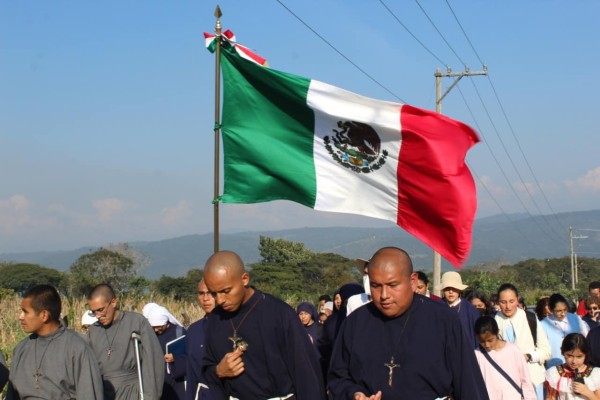
However, that was precisely one of the features the immaculate heart family in Chiapas was ready to mimic from the Heralds of the Gospel’s semiotics, as the pictures before and after this paragraph prove.
And then, finally, even if Rome sides with archbishop González, there is the issue of what is going to happen with the properties. This religious group has a massive compound in the municipality of Berriozábal, West of the capital city of Tuxtla Gutiérrez.
Comparisons
It is unclear how big the Real Estate of what Google Maps identifies as a “spirituality center” actually is, but even if one went only with what appears as already built or in the process of being built, it is a compound of more than 41.2 metric hectares or near 102 acres.
For comparison’s sake, the total territory of Vatican City stands a bit under 50 hectares, or 110 acres but, once again it is impossible to calculate the actual land mass of the property in Berriozábal.
There is no indication as to who would take control of such property, as there is no access to information about other assets that, if suppression is actually final, would have to be allocated. As there are several chapels in the compound it is unclear if the Real Estate where such chapels are located was already transferred to the Mexican government, standard practice for places of worship.
There is no indication as to who holds a title or titles over such massive property near the capital of Chiapas. Going back to the issue of the suppression of the Sodalitium, a few months ago, this series went over the nightmare making very difficult to expect that Leo XIV’s expressed wish of using the Sodalitium assets to pay reparations is even possible.
As Luis Cabrera, a journalist from the 20th century in Mexico used to yell at politicians: “I am calling you a thief, not an idiot.” Organizations intent on carrying out predatory and sectarian behavior, are well aware of the need to bury the legal ownership of their properties upon layers of legalese.
A previous installment of this series showed how in the case of the Peruvian Sodalitium (see above, especially in the section titled “Competing for alms and souls”) their members used an assortment of straw-firms or “straw-NGOs” to protect the ownership. Chances are in the Public Notaries of Tuxtla Gutiérrez there are books filled with the records of many maneuvers to shield that Vatican-upon-the-Grijalva.
This additional dimension makes the hurry to suppress the group all the more intriguing while forcing any observer to question what was really happening there that forced this unusually swift action. Was abuse, sexual or otherwise, a factor?
Over social media, on accounts from people living in Tuxtla Gutiérrez, it is possible to find the usual references to what one reads in reports on spiritual abuse in the Legion of Christ, Opus Dei, the Institute of the Incarnate Word or the Sodalitium.
There are references to a kind of discipline described as “ferocious,” close to sectarian control, similar to what one can find up until now in Opus Dei or the Regnum Christi (Kingdom of Christ), the “lay” arm of the Legion of Christ, rendered as requests for blind obedience that, according to the social media postings, flirt with slavery or labor exploitation.
In religious matters one finds the usual references as to how the internal structure of discipline was enforced through confession and the actual denial of the so-called “inner forum,” that is to say, one’s ability to make one’s own decisions. There are stories of humiliation, similar in all respects to what we know now of Fernando Karadima’s methods in Chile, to “house-break” candidates to religious life.
So-far, the suppression moves at neck-breaking speed. As early as Saturday afternoon, the order’s main website was already reporting “404s” instead of the usual display of carefully selected images about life inside the compound. Some of those images are only available now over the Internet Archive.
Even if one was willing to be hopeful and to try to build a long-term narrative based on the potential influence of prefect Brambilla in influencing the suppression of the group in Chiapas, it is impossible to forget how in the last hours of March, Pope Leo XIV’s decision to appoint Laurent Devolvé as a member of Tutela Minorum came as a shock for Catholics in the French-speaking world.
Delvolvé is indeed a prestigious French lawyer with a knack for defending organizations with very sectarian practices, similar at least to those of the recently suppressed Mexican group. Devolvé went to war to protect the Emmanuel Community, which has been under its own Apostolic Visitation since March 2025 due to governance “tensions” and internal stalls.
As inspiring as the decision in Chiapas could be, how to reconcile it with Devolvé’s appointment. It suggests that while González, with some input (one would guess from Brambilla is suppressing a group like FRICYDIM, the Pope himself is giving a seat at the table to the chief architect of legal defense for a rather large sectarian player.
Is Rome actually moving against sect-like practices or is only moving against a specific group, one unable to find a Mexican Devolvé willing to help them navigate the corridors of canon law trials?
It is actually impossible to figure the riddle out. And that is what makes harder to assess the potential implications of what has happened in Chiapas, what could happen in Brazil with the Heralds of the Gospel, how the Sodalitium 20-year drama could end and, more broadly, how the Catholic Church will try to grow without endangering its own faithful.
Post-Data: Letters from Ciudad Juárez
This week the father of a victim of clergy sexual abuse in Ciudad Juárez, whose story was told in detail in a series of which only two installments are available in English, linked further down, sent to several media in that border town and elsewhere in México a gut-wrenching letter where he goes over the how the diocese of Ciudad Juárez has been dealing with his daughter’s case for almost than five years now.
The alacrity with which the Tuxtla Gutiérrez archdiocese closed the books on the order at the center of today’s installment, contrasts with the dull, lethargic theatricality with which a diocese on the other extreme of Mexico deals with its cases of clergy sexual abuse. What follows is the letter.
Ciudad Juárez, Chih. April 8, 2026
Fr. Gustavo Balderas Soto, Head of the Diocesan Commission to Prevent Sexual Abuse and Attention to Victims of Sexual Abuse, diocese of Ciudad Juárez, Mexico.
To the general public
Fr. Gustavo Balderas,
Once again I address you in response to your call over an an interview broadcast in Circuito Frontera on February 25 of this year. In it, you accept that "the bishops" do not pay attention to Church reports of pedophilia and other classes of sexual abuse committed by priests. The treatment of such grave “faults” is established in a corpus of documents composed of: various papal mandates issued since 2014; the Guidelines for Attention to Victims of Sexual Abuse by a Cleric (Mexican Conference of Catholic Bishops, 2016); the Protocol of intervention in cases of sexual abuse (Archdiocese of Mexico, 2022); by the revision of book VI of the Code of Canon Law of June 1, 2021; by the so-called Vademecum on some procedural issues regarding cases of sexual abuse of minors (sic) committed by clerics (Congregation for the Doctrine of the Faith, June 5, 2022) by countless documents and communiqués prepared by the Center for Interdisciplinary Research and Training for the Protection of the Minor (sic), not to mention the Catechism of the Catholic Church and the Gospels themselves.
These documents are dead letter in the diocese of Ciudad Juárez; I have sufficient evidence to prove my statement. You made an invitation to seek the “Diocesan Commission,” you preside and tasked with attending to such matters. In that context, on March 2 and 6, I contacted your office at the Jesus Prince of Peace parish, where you are the pastor. I let your secretary know that I needed to speak with you to discuss a topic related to the “commission,” I gave her my contact information. Given your lack of response, I went to look for you in person on March 10 to deliver documents. When I requested your secretary to stamp and sign my copy to acknowledge receipt, she consulted you and, your response via messaging, was that I should deliver them to you in person. Even though you were made aware of the gravity of the matter, you did not set a date and time for us to meet, nor did you even ask for the call to be transferred.
On March 17, Circuito Frontera broadcast a public letter addressed to you in which I point out irregularities, abuses of power and falsehoods in which your superior, bishop José Guadalupe Torres Campos, other clergymen of the diocese of Ciudad Juárez and you have incurred when you address the cases of clerical pedophilia committed in Juárez. To this day, you have not responded to the mentioned document. In view of the above I want to specify:
1) Even though the matter that occupies us has been known by you since April 2021, the “commission” has never made an attempt to get in touch with me.
2) From March 3 to 5, you attended, in your capacity as head of the "commission", the CEPROME Latin American Congress "Repairing the damage. Between the faith that sustains, the care that accompanies and the justice that restores", in San José, Costa Rica. I ask you, refusing to receive documents in which you are implicated and facing the victims, are they part of the mechanisms to "repair the damage"? You, your bishop José Guadalupe Torres Campos and Fr. Dr. Dr. Guadalupe Daniel Portillo Trevizo, head of CEPROME, can turn your gaze away, but the victims are not going to disappear.
3) I waited a couple of weeks to receive your response to my open letter, you cannot claim you are still busy as you were during the last days of Lent and Easter. For the third time, I demand you answer my request to set a meeting. I am not asking for a courtesy nor a deference, I demand that you fulfill your obligation. If you are accustomed to treating such delicate topics between your Sunday masses, I regret to inform you that I am not going to lend myself to the simulation of being attended.
4) Refrain from answering by using theological ambiguities or moral generalizations in your interventions in the media. Clerical pedophilia and episcopal cover-up are very serious “faults” that deserve particular and immediate attention; if “measures to preventi abuse” actually was policy in the diocese of Ciudad Juárez, there would not be as many victims as they are.
5) Likewise, I demand you refrain from giving revictimizing declarations in the media; claiming that “a ‘commission’ to prevent abuse exists,” that “victims are listened to” or that you “apologize on the Church’s behalf,” as such statements are a mockery for those who have suffered from “disobedience to the sixth commandment” by some of your colleagues. Your silence speaks for itself of the conditions we live in Ciudad Juárez. The unpunished acts of clerical pedophilia and the episcopal cover-up network that intends to hide them are an undeniable reality.
6) Now I call you take the multiple public statements made by Fr. Dr. Dr. Guadalupe Daniel Portillo Trevizo in which he refers to sexual abuse, to their respective cover-up and to the measures followed by the “apostolate of prevention” (articles, books, videoconferences, essays, communiqués, presentations, short courses and even his degree theses) and explain how all that rhetoric is applied in the crude reality. The “commission” you talk about, does not exist. To corroborate it, it is sufficient to enter the page of the diocese of Ciudad Juárez Why is there no information in the section of prevention of abuse? And if that "diocesan commission" existed, why so much opacity in its proceeding? What is it that you try to hide?
I hold responsible all those pointed out in the ecclesiastical reports I have presented since November 3, 2021 to the date, of threats, vandalism, physical aggressions, institutional violence, cyber espionage, injuries, forced disappearance or any class of reprisal that the members of my family or I could suffer.
Dr. Jorge Ordóñez Burgos
ATTENTION TO:
- Congregation for the Doctrine of the Faith
- Congregation for the Clergy
- Dicastery for Bishops
- Pontifical Commission for Latin America
- Monsignor Joseph Spiteri, apostolic nuncio to Mexico
- Card. Jaime Spengler, President of the Latin American and Caribbean Episcopal Council
- Monsignor Francisco Javier Acero López, auxiliary bishop of the Archdiocese of Mexico and member of CEPROME
- Monsignor Ramón Castro Castro, President of the Mexican Conference of Catholic Bishops
- Monsignor Constancio Miranda Weckmann, archbishop of Chihuahua
- Ecclesiastical Tribunal of the archdiocese of Chihuahua
- Most. Reverend Mark. J. Seitz, D.D. 6th. bishop of the diocese of El Paso, Texas
- Fr. Dr. Dr. Guadalupe Daniel Portillo Trevizo, Director and Founding member of the Center for Interdisciplinary Research and Training for the Protection of Minors (sic)
- Executive secretariat, of the Inter-American Commission on Human Rights, Case 605-P-22
* * *
A summary of this piece is available as audio after this paragraph.
Your browser doesn't support HTML5 audio. Here is a link to the audio instead.
Note on production: The text of this summary was written and edited solely by the author. The delivery of the audio summary was achieved using a high-quality, text-to-speech engine Microsoft Word for Web. The AI was used for voice generation only, not content creation.