
Rodolfo Soriano-Núñez Miércoles, 25 de Marzo del 2026
Regardless of the consequences, high-ranking prelates such as archbishop Rogelio Cabrera, protect clerics under their charge while destroying victims of abuse.
The new book Forgive Them, Lord offers the details of those attempts to destroy the author, as well as a devastating account of her experience as an abuse survivor.
By Rodolfo Soriano-Núñez
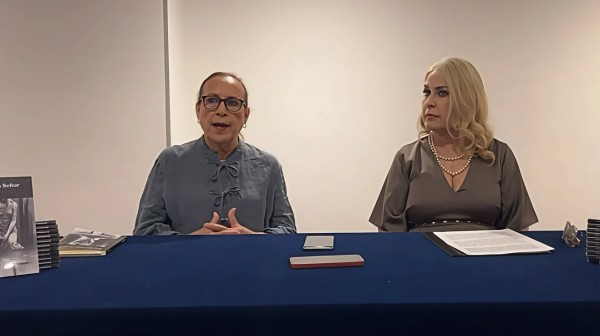
This Tuesday, shortly before noon, the city of Monterrey witnessed a painfully frequent and, at the time, hopeful event: a survivor of sexual abuse who kept her experience and pain in silence for several decades liberates herself by presenting a book in which she tells her experience.
The details of her experience can be found in the book Perdónalos, Señor (Forgive Them, Lord). The title reveals the way in which the author, Sandra Valdez, summarizes her trauma experience. It is not primarily an act of denunciation, although it does include it. It is an statement of a survivor liberating herself from the heavy burden of the harm caused by an experience that she neither sought nor provoked, but which unfortunately in Mexico continues to be viewed with suspicion.
Sandra is blunt in the allegations she makes regarding priests and bishops of what was her religion, including the one who attacked her, Erasmo Morales Manzano. Notably, the Monterrey parish where he used to serve until his death in 1989, that of Saint John Bosco (content in Spanish) still has his name as a former vicar there.
Morales Manzano died years ago. However, the sequels of the attack, the long-term effects, and the complicity created to silence or minimize even now the effects of the abuse remain there.
Respect
As Cristina Sada Salinas pointed out during the book’s presentation, Perdónalos, señor, “is not only about a personal catharsis, but mainly about the urgent need to socialize her terrible experiences, ‘her pain that never ends,’ to try so that we as a society find out and take charge that ‘this does happen,’ before which we should commit ourselves.”
Sada Salinas is the driving force behind Spes Viva, a Mexican NGO promoting respect for human rights and that, more specifically, advocates for survivors of sexual abuse and other forms of violence in Mexico.
Given that the predator passed away, no judicial process is to be expected that would disturb the sleep of the Mexican Conference of Catholic Bishops, although in other scenarios, in which Mexican police and courts took their tasks more seriously, it would be possible to imagine institutional consequences for the Archdiocese of Monterrey.
One only must see what has happened in the United States in archdioceses such as Los Angeles, Boston, or New York to see the way in which the argument of institutional responsibility can be built, for Morales Manzano did not operate in a vacuum. His superiors included first Alfonso Espino Silva, archbishop from 1952 to 1976; José de Jesús Tirado Pedraza, who was the incumbent from 1976 to 1983, exactly when the two attacks on Sandra occurred; and Adolfo Suárez Rivera, who took over in 1983 and retired in 2003.
All of them had institutional responsibilities regarding Morales Manzano’s predatory behavior, which have been minimized, denied, and evaded even when, in 2018, the current archbishop of Monterrey, Rogelio Cabrera López, agreed to have a meeting with Sandra.
Far from showing any interest or empathy with what Sandra experienced, Cabrera López settled into his hierarchical position, in a rigorist interpretation of both Mexican legislation and, above all, of what all popes from John Paul II until, at that moment, Francis have said regarding the sexual abuse crisis.
Trapped in a contradictory dynamic, in which Leo XIV himself, like Francis before him, fails to convince “his brother bishops” to comply with what they are asked to do and in which, furthermore, abuse is spoken of in one way in Spanish and in a very different way in English or silence is kept, Cabrera López, who was president of the Mexican Conference of Catholic Bishops from 2018 to 2024, eluded both his personal responsibility, which exists regarding the attention to historical cases such as Sandra's, and the institutional responsibility of the archdiocese of Monterrey at large.
Facing facts
And it is not as if Sandra was waiting for some compensation that would make her a millionaire. What she expected from the meeting with Cabrera López was the archbishop’s acknowledgement the reality of clergy sexual abuse in Monterrey, something the archbishop was unwilling to do during their meeting.
It is enough to point out that, in Mexico, 44 percent of the Catholic dioceses are still unwilling to comply with the bare minimum Pope Francis’s asked: setting up a commission to prevent abuses in each diocese, as the story linked after this paragraph proves in its can be confirmed in the text linked after this paragraph in the section, “Low-quality data.”
Sandra has managed to process the damage caused by the two instances of rape perpetrated by Morales Manzano in the 1970s, but it was not because of any help from the institution for which the predator worked, to which, in the logic of the Catholic Church, he “dedicated his life.”
Sandra was able to do so because she has been working on her own case, with the help of mental health professionals over the last five decades. One of the peaks of such process has been, precisely, publishing the book she and Cristina Sada Salinas presented this Tuesday in Monterrey.
Those who insist on denying the depth of the crisis have turned suspicion into a weapon and an art against survivors such as Sandra. They do so by using the Cristero War and what came after it in Mexico as “evidence” of an all-encompassing anti Catholic conspiracy threatening their very right to believe in God.
What they miss is that, in doing so, they hurt the Catholic Church’s ability to understand the true extent of the damage, as they found easier to attack survivors who go through their experience in deep isolation, guilt and pain.
A few weeks ago, the Monday’s series Los Ángeles Press publishes dealing with the sexual abuse crisis went over Alicia Garza Martínez’s case and how she was summarily fired by Universidad de Monterrey, a private college there.
University of Monterrey tried to destroy her by firing her from her job for asking students in an English class to read news in English that, for reasons beyond her control, included at some point news about sexual abuse in the archdiocese of Boston.
Siege mentality
The same attitude leading Universidad de Monterrey to fire Alicia has been drilled into the minds of the Mexican Catholic faithful to the point of making any criticism an attack, and any critic an enemy who must be excommunicated first and destroyed if necessary.
What Sandra's case shows is how that attitude, when dealing with the direct victims of abuse, becomes a system that covers up abuse, that tolerates it, “softens” it, encourages it, and even rewards it when the predator is “successful” in other areas of his public life, especially when he is a good organizer and even more when he is, above all, a good fundraiser.
It is worth noting that, although Sandra was not a ten-year-old girl, she was a 16-year-old adolescent, she had lived her entire life in “Catholic environments,” a student at a nuns' school in Monterrey, her sisters worked in the archdiocese of that city, and her house was frequently visited by prelates of the time who, as she proves in her book, were already aware of what was happening in the parish where she worked as a volunteer.
Something that many Catholics in Mexico and Latin America still have trouble accepting is that the victims are usually the people closest to the priests, those who trust them most simply because they are priests. This made Sandra a “perfect victim” and, as she describes in her book, Morales Manzano, “her” predator, was aware of his power and his ability to use that cult mentality, straight out of a state of siege, against a 16-year-old girl whom, in Morales Manzano's logic, no one in the very Catholic Monterrey of the seventies was going to trust.
Sandra's case is, in that sense, a carbon copy of what happened to Silvia, a survivor under an assumed identity, also a woman, also the object of repeated attacks by at least two priests and of the culture of silence, impunity, and mutual cover-up that exists both in Monterrey and in the diocese of San Juan de Los Lagos, in the heart of the Mexican Lowlands, the so-called Bajío. Silvia's story is available after this paragraph.
Same play, different actors
What is worse, it is similar to the Felipe Berríos’s victims in Chile and Marko Rupnik’s in different European countries, which were reported in the story linked after this paragraph. Since all these cases are of female victims, they contradict Benedict XVI’s lazy narrative claiming the sexual abuse crisis was the by-product of gays infiltrated into the Catholic Church as priests, for they are all cases of female victims.
And indeed, that is the ordeal that Sandra narrates and to which Rogelio Cabrera López subjected her again when him, the archbishop, dedicated a few minutes of his time in 2018 for an audience. Unfortunately, the encounter only confirmed Sandra's worst suspicions as she faced a bishop who simply wanted to end the meeting and move on to the next item on his agenda.
Cabrera turned 75 just this January, so it is inevitable that at any moment a successor will be appointed who, if he were sensible, should learn from the mistakes of the current incumbent of the archdiocese.
Sandra's brief book is one more of the examples that prove how dangerous it is to insist on presenting abuse cases as a problem defined, to a greater or lesser extent, in the logic of pedophilia.
Sandra, as many other people, women and men, was not a victim of abuse when she was a child. She was one when she was already an adolescent and months after having started providing her services as a volunteer in the offices of one of the most prestigious parishes in Monterrey.
Back on Monday Los Angeles Press offered an account how the Catholic Church defangs its own narratives regarding abuse depending on the language of choice, and how the media covering what happens in it mimics that attitude as the focus remains on the victims’ age.
After this paragraph, as a PDF, the introduction and a fragment of the first chapter of Sandra Valdez's book are included. Whoever wishes to get it can contact her directly at her email address ssandravaldez@gmail.com, although the book is only available in Spanish.