Rodolfo Soriano-Núñez Martes, 12 de Noviembre del 2024
Castro is friends with U.S. Bishops close to Trump and with Mexican surrogates of the President-elect. Will they help him broker the deal on migration?
Could those relations help him broker a deal the Mexican government is in desperate need to avoid a migration and economic catastrophe?
By Rodolfo Soriano-Núñez
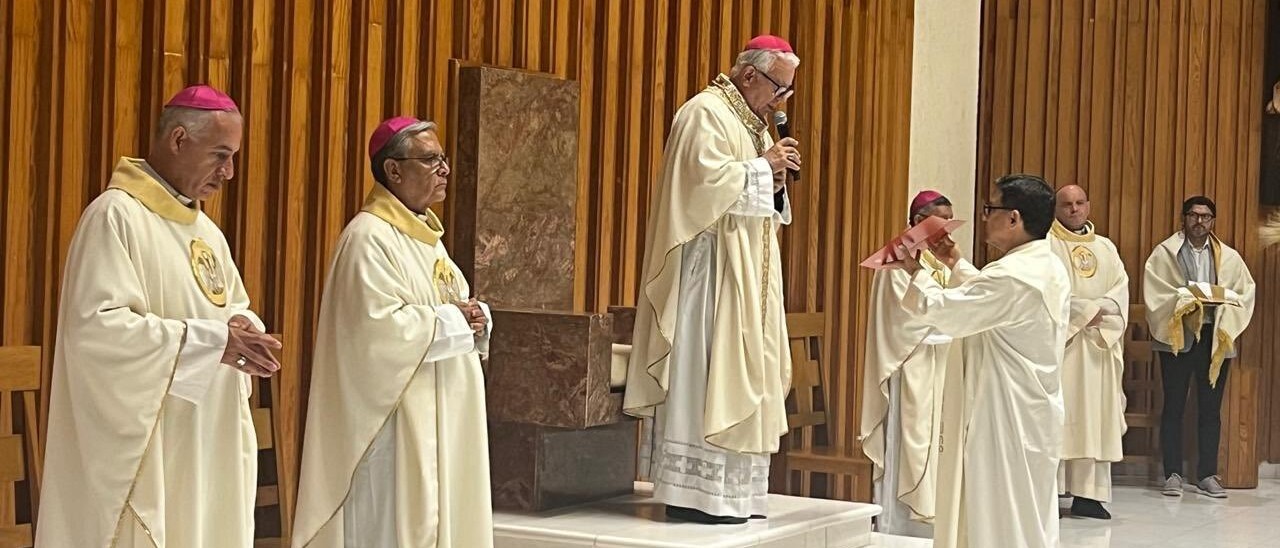
Early on Tuesday, at Izcalli, a suburb of Mexico City, where over the weekend a new massacre happened, the Mexican Conference of Catholic Bishops (or CEM, its acronym in Spanish) inaugurated its general assembly.
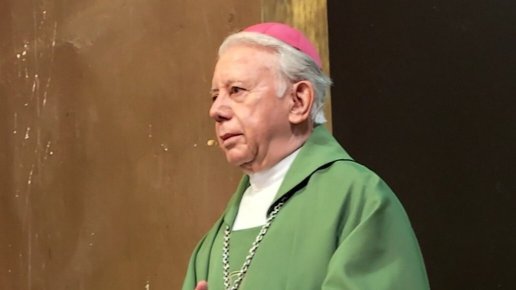
This assembly was special because the bishops appointed a new board. The new president is Ramón Castro Castro, current bishop of Cuernavaca, capital city of the central state of Morelos. He was up until yesterday the general secretary of the Conference and, before that, he was CEM’s Treasurer.
The new vice president is the archbishop of León, in the central state of Guanajuato, Jaime Calderón. He was up until August, the bishop of Tapachula, Chiapas, the Southernmost state of Mexico.
The new general secretary is Héctor Mario Pérez Villarreal. He is an auxiliary bishop in Mexico City. His appointment comes after the realization that being the acting bishop in a diocese while also being CEM’s general secretary was a taxing task, so the conference went back to its tradition of having an auxiliary bishop in a large archdiocese as the general secretary.
The press release from the Mexican bishops is available as a PDF after this paragraph, only in Spanish.
The Mexican Bishops Conference statement about their new board.
The election of the new board at CEM comes a week after Donald Trump’s triumph in the United States presidential election. It used to be the case that those two issues were completely unrelated, but this time around things have changed.
Ramón Castro is not only the bishop of a small diocese, but he is also a former Vatican diplomat. A disciple of Juan Jesús Posadas Ocampo, the archbishop murdered in 1992 at the airport of Guadalajara, Mexico, when allegedly drug lords thought he was the leader of a rival cartel and killed him.
Posadas Ocampo, during his tenure as bishop of Tijuana, sent Castro to study at the Vatican’s school of diplomats, the Pontifical Ecclesiastical Academy. He graduated there and by the late 1980s he was working in Zambia and Malawi (1989-92), and then he went to Angola (1992-4).
From there, he jumped to the then relatively new Nunciature to Ukraine (1994-6), and from there as second at the Nunciature to Venezuela (1996-9) then under Argentine archbishop and current Cardinal Leandro Sandri, who later would be the nuncio to Mexico. Castro ended his tour of duty as a Vatican diplomat at Paraguay (1999-2001).
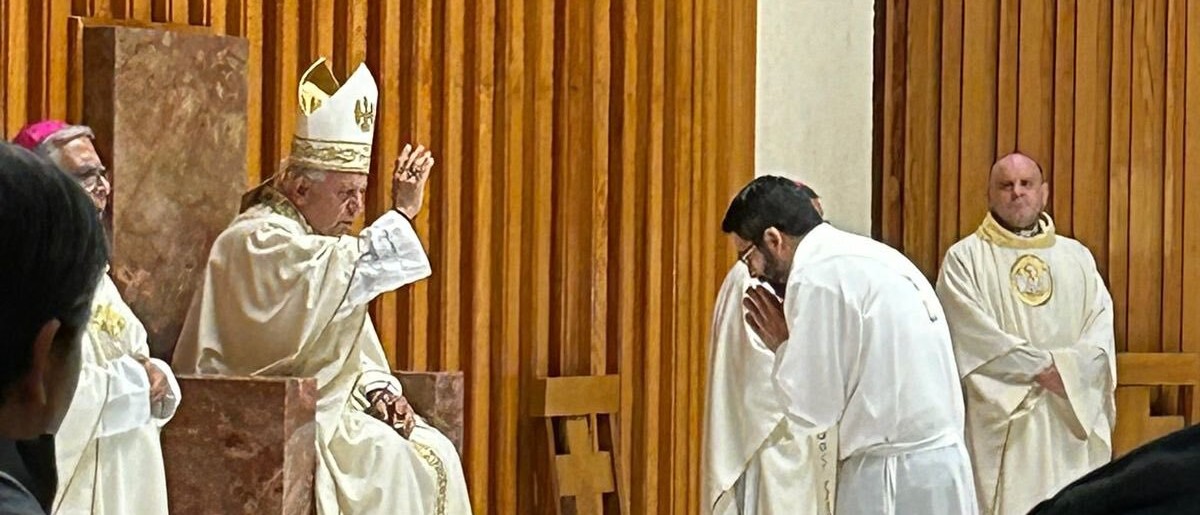
That year, John Paul II appointed Castro as head of Peter’s Pence, a special collection all Roman Catholic churches around the world send once a year to Rome.
It is unclear what happened with Castro, but instead of becoming a nuncio on his own, in 2004 Karol Wojtyla appointed him as auxiliary bishop in Yucatán. His boss there was Emilio Berlié Belaunzarán, who was—as Castro himself—a disciple of Posadas Ocampo. Berlié Belaunzarán was also his superior, since John Paul II appointed him to Tijuana as Posadas Ocampo's successor. Berlie Belaunzarán also approved Castro studies in Rome.
Castro spent two years there. Notoriously, several sources talk about some sort of meltdown between the archbishop and his auxiliary. However, since they stick to the secretive practices of their Church it is almost impossible to figure out what really happened there, but in 2006 Benedict XVI promoted Castro to bishop of Campeche.
There, he would have his first controversial handling of cases of clergy sexual abuse as bishop. It is impossible to go into the details, but there is a long paper and electronic trail of accusations and even insults between former priests, now with a rival local church and bishop Castro.
On clergy sexual abuse Los Angeles Press has been publishing a series devoted to the issue. Sadly, the only installment we have published dealing with Castro’s record as bishop and his attitude towards priests accused of that kind of behavior is available only in Spanish and linked below.

There we tell the story of how Castro has Fernando Moriel as a parish pastor and as the head of the area dealing with the formation of the permanent deacons in the diocese of Cuernavaca. A victim of clergy sexual abuse accused Moriel when he was a priest in the archdiocese of Chihuahua and a professor at the seminary of that Roman Catholic circumscription.
What is worse. As the story linked below proves, as soon as Castro became the general secretary of the Mexican conference of bishops there was a sudden drop in the number of dioceses willing to set up a commission to prevent clergy sexual abuse.

That pattern is more troubling when one takes into consideration that, despite the evidence to the contrary, the Mexican bishops claim to be in full compliance with the Vatican’s request to set up those commissions as the story linked below proved two weeks ago.

The Catholic Church’s report on clergy sexual abuse
In any case, surfing on the red wave of Trump’s triumph, Castro became this Tuesday the president of the Mexican conference of Roman Catholic bishops.
Surprisingly, that very day, during the daily activity the Mexican President holds in National Palace (see the video below), Claudia Sheinbaum informed she would be going to meet with CEM’s new board today Wednesday.
Claudia Sheinbaum informs she will be going to Izcalli to meet with the new leaders of CEM. Audio only in Spanish.
It is not clear if the Mexican government is aware of Castro’s links and connection with the most radical pro-Trump and anti-Francis faction of the USCCB, but he has them.
Also, Castro has been one of Eduardo Verástegui’s more enthusiastic supporters at different points in time. Verástegui has the backing of the Slim family, especially that of Patricio or Patrick as he likes to be called when traveling to English-speaking countries.
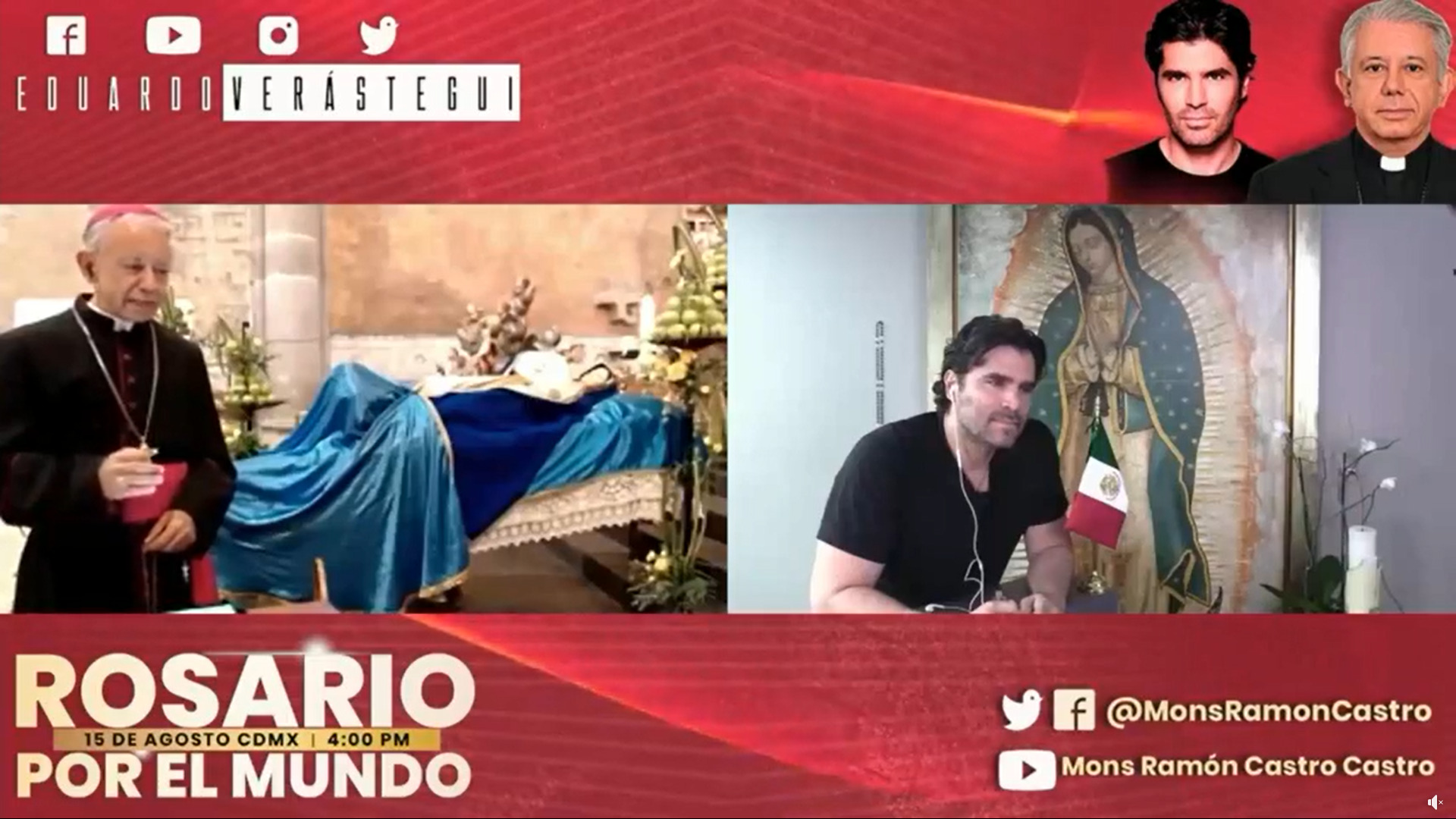
In the video linked at the end of this sentence, from 2020, Castro joins Verástegui to pray the rosary over a Facebook broadcast. The screenshot after this paragraph comes from that broadcast.
Patricio is one of Carlos Slim’s sons. The Mexican telecom mogul was known for his open support for Marcial Maciel, so nobody in Mexico is surprised when the relation between Verástegui and the Slim family comes up.
Los Angeles Press ran a four-part series on Verástegui’s role as a key figure in the Mexican Roman Catholic far-right. The first installment of that series appears below, and the others will appear through this story.

The curious case of Citizen Verástegui
Most of Verástegui’s activism aims at linking Mexican and Latin America conservatism, with their U.S. and European counterparts. Back in 2023, he was unable to gather enough signatures to become an independent candidate to the presidency, but he remained somehow active in the first semester of this year calling his supporters to write him in the Mexican presidential ballot.

He frequently attacked Xóchitl Gálvez, Presidential candidate of the Mexican opposition front to Morena’s current government, disparaging her for being unwilling to support a full ban on abortions, and for not making abortion and even contraception a basic feature of her campaign.

But as depicted in that four-part series, Verástegui is also very active in U.S. politics. One of the pictures included in that series have him greeting none other than Roger Stone, a figure hailing from the Nixon era.

The Verástegui Network, a dystopian and authoritarian world
Verástegui’s relation with Donald Trump goes back to his second presidential campaign, when the now President-elect made Verástegui a liaison with Latino communities in the U.S.
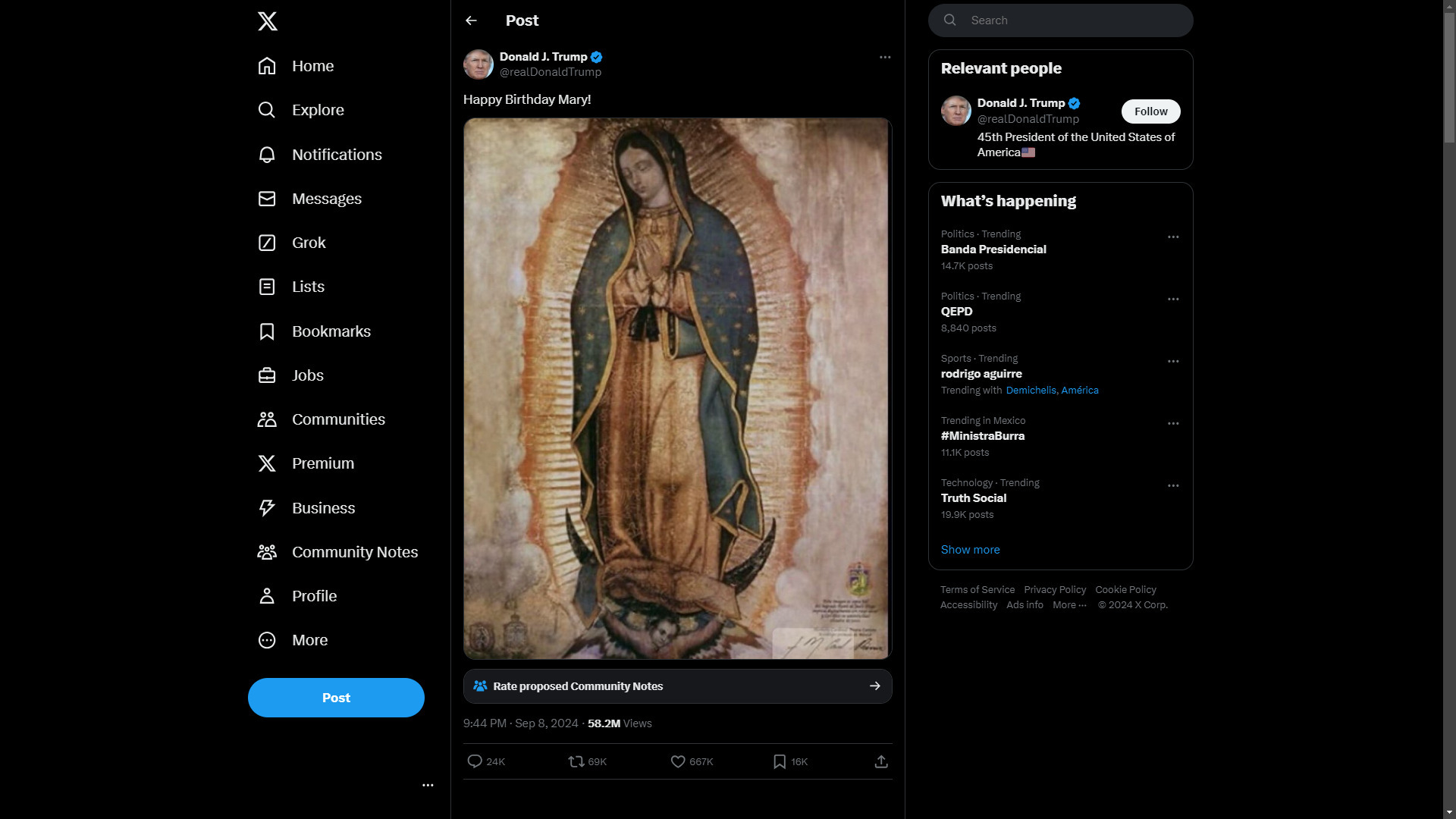
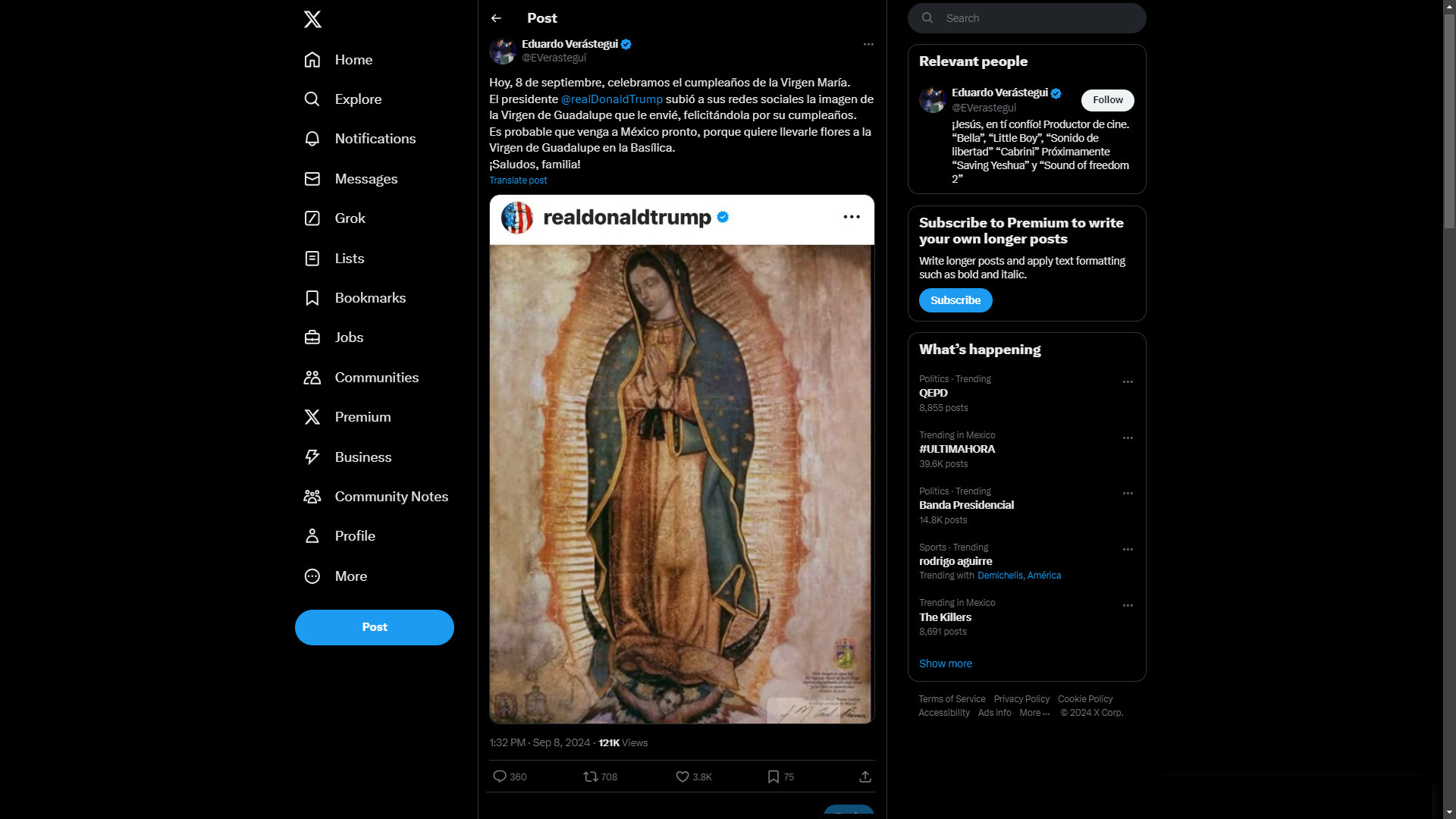
Already in the 2024 campaign, Trump saw fit to “congratulate” Mary, mother of Jesus, for her birthday at his social media accounts, Verástegui ran to repost, translate, and celebrate Trump’s attitude, more notorious since he was not using an Italian or German depiction of Mary, but the very Mexican image of Our Lady of Guadalupe.
Verástegui also played a role in promoting Javier Milei, Argentina’s current President, who will be in Florida to meet with Trump this week. Verástegui brought Milei to Mexico when Milei was only a marginal candidate, as the picture immediately after shows.
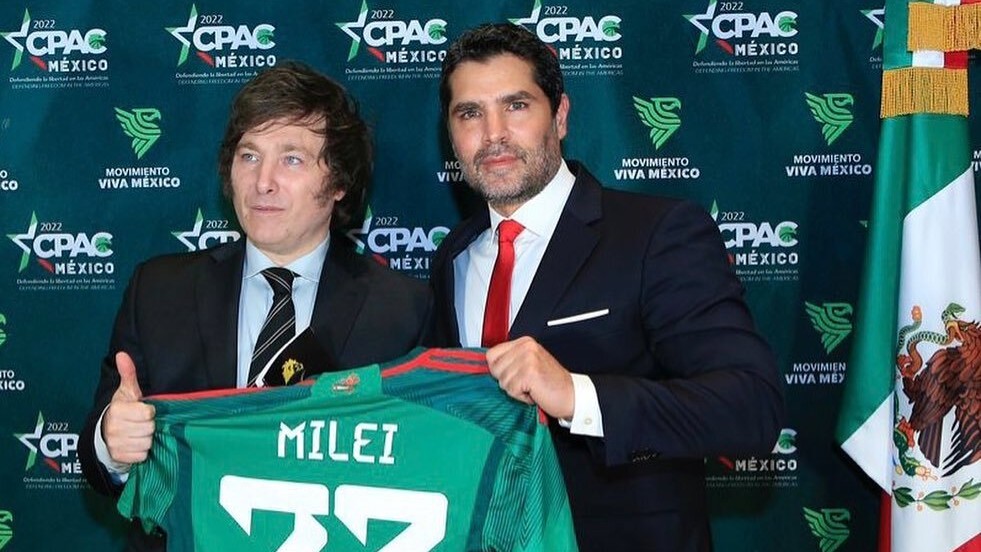
And the same goes as far as building links between his brand of conservatism and figures of the European far-right as Italian current Prime Minister Giorgia Melloni or Hungarian President Viktor Orbán.
More important are Castro’s and Verástegui’s ties with the most radical wing of CEM’s counterpart, the United States Conference of Catholic Bishops, USCCB.
Said wing, where one finds the archbishop of Los Angeles, José Horacio Gómez, originally born in Monterrey, Mexico, his colleague, the archbishop of New York, Cardinal Timothy Dolan; the current leader of USCCB, the military bishop of the United States Timothy Broglio, and Robert Barron, the now bishop of Winona, Minnesota, but also the former auxiliary of Gómez in Los Angeles, and the bishop of the U.S. conservative celebrities.
That wing has been notorious for their deaf opposition to Pope Francis, and their attacks on Joe Biden, the Roman Catholic President for not being “Catholic enough.” Biden’s attitude towards abortion earned him criticism from the most conservative quarters of Roman Catholic social media, both in English and in Spanish, as much as disdain from the USCCB leaders.
In that respect, Trump’s success is full of attached meanings for the Roman Catholic Church in the United States and in Mexico. Trump, on the other hand, toyed in social media with symbols dear to Latino Catholics in the United States that have been already under siege, as the piece published by Los Angeles Press in late 2023, linked below proves.
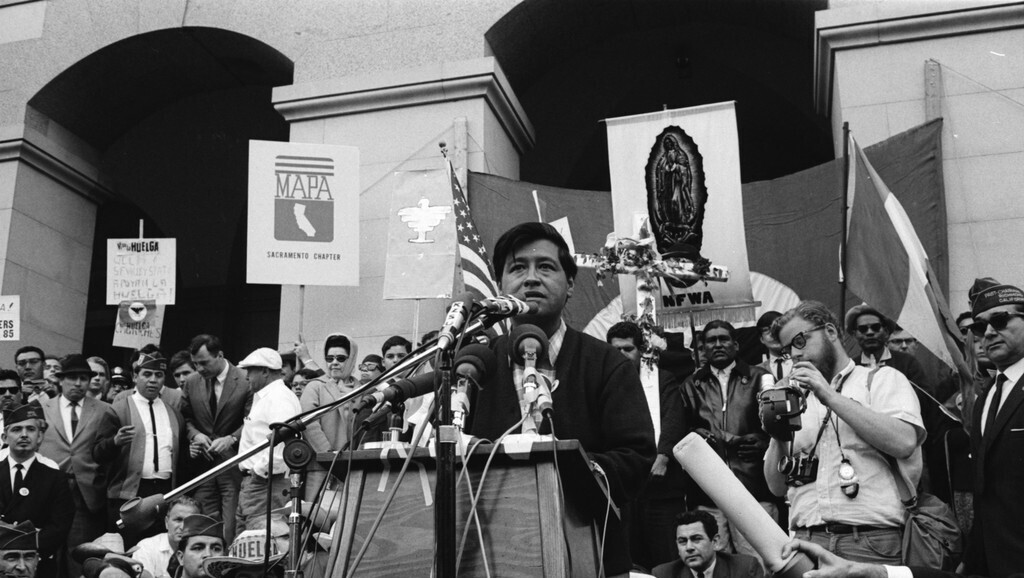
The kidnapping of Our Lady of Guadalupe
As stated in that story, a key player in that process has been the aforementioned Mexican soap-opera actor Eduardo Verástegui.
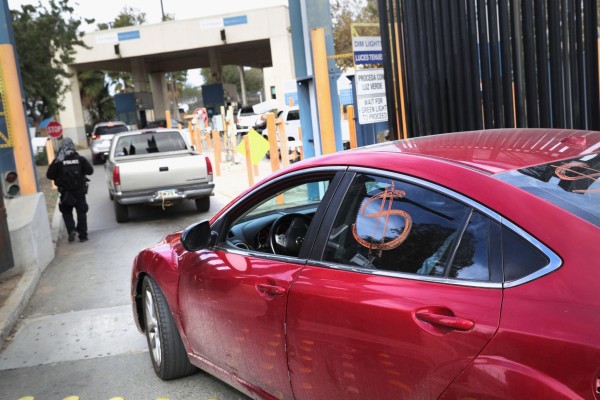
Desperados at the border
The Mexican bishops know Claudia Sheinbaum and the Mexican government are in desperate need of some opening to at least having some say in how the potentially massive deportations of undocumented persons living in the United States and even their U.S. born children will happen.
It is not clear for me if the U.S. bishops will be willing to endanger their relationship with the second Trump administration, and it is even harder to know if they would do it for the sake of Mexican and broadly speaking Latin American undocumented migrants at risk at this point.
Also, it is not clear for me what will the Mexican bishops seek in such a bargain. Their policy preferences are known. The most pressing issue for them, despite their current criticism of violence in Mexico, is abortion. Will Claudia Sheinbaum be willing to step back on the issue in exchange for some assistance from the Mexican bishops?
I do not claim to have any special insight on neither the current Mexican government nor on the kind of support that U.S. bishops would be willing to offer the Mexican government with the Mexican bishops as intermediaries of such deal.
But, after the experience in countries like Nicaragua I am aware of how far are the Roman Catholic bishops willing to go to strike deals they perceive as advancing their interests on the matter of abortion.
All I know is that the Mexican government is well aware of how weak the Mexican economy is, how much it depends on having access to both the U.S. markets of goods and capitals, on keeping remittances coming and on avoiding a migration-derived disaster as a consequence of Trump's policy choices.
Trump is well aware of that. On the first Trump Presidency, Mexico only got from Trump the concession of not assuming the title of “Safe Third Country.” Back in the aughts, Canada accepted that denomination. When Mexico eluded that risk, Guatemala, Honduras, and El Salvador were not that lucky.
In doing so, Mexico was able to avoid the 25 percent tariffs Trump was already willing to impose back then. Now that he enjoys almost unlimited powers in his country it is hard to imagine what could prevent him from imposing that kind of tariffs or more brutal and regressive policies aimed at “making America great again” on trade or on migration.
Even if then Mexico was able to avoid the tag, the Remain in Mexico policy forced Andrés Manuel López Obrador to provide some kind service to the United States by accepting the presence of migrants desperately trying to leave Mexico, but unable to actually do so, because the U.S. government under Trump was unwilling to receive them.
Back in 2020, an academic journal published an essay where I go into the details of what happened migration-wise between Mexico and the United States at the time. The essay, in English, is available here, and it appears in the box immediately after.
Migration and (de)colonization in the Mexican government migration policies, 2018-19
The situation was unsustainable as the fire that killed forty migrants in a “refuge” in Ciudad Juárez proved. It was not an actual “refuge” it was closer to a jail, as they were forced to be there under constant danger of what ultimately happened there, as the story from Propublica, available here, tells in detail.
It is hard to imagine that the new Trump administration would be willing to be more creative and harder to imagine them trying to figure out a humanitarian approach to migration.
In any case, the new president of the Mexican Conference of Roman Catholic bishop got his wish granted. As new leader of the Church here he will have plenty of time and coverage in national and international outlets to insist in his preferred policies.
The world will be watching what he is able, or not, to achieve as a result of the special relation he enjoys with people close to Donald Trump as his brother U.S. bishops or as Eduardo Verástegui.