Rodolfo Soriano-Núñez Sábado, 01 de Julio del 2023
On the 40th anniversary of the sexual abuse crisis, Bishop Richard Stika of Knoxville, Tennessee, is the 100th bishop forced to resign.
Religion and public life: Jason Berry and Richard Sipe provided two key elements to understan the clergy sexual abuse crisis an accountability-centered-narrative and the so-called scarlet bond.
By Rodolfo Soriano-Núñez
Sometime in July of 1983, then priest Gilbert Gauthe was relieved from his duties at the St. John parish in the Lafayette diocese in Louisiana. His dismissal, accurately depicted by Jason Berry in a series of stories published in 1985 started what we now see as the 40-year long crisis of sexual abuse in the Catholic Church.
For the last four decades a deluge of news about sexual predator priests has been inundating news outlets all over the world. In all its misery, the crisis has helped make the global public opinion aware of the crisis in the Catholic Church, in other religious organizations, and in many other institutions and settings.
When one compares Gauthe to other world-known predator priests such as the Mexican Marcial Maciel, the Chilean Fernando Karadima, or the Australian Gerald Risdale, with the 72 charges that got him locked up at the Port Phillip Prison in Australia, there is nothing special in Gauthe.
He is the name we can use as the starting point of what is now a global crisis, with devastating consequences for the oldest institution in the Western world and ramifications in other realms of collective behavior. Nowadays, politics, finance, academics, sports, fashion, showbusiness, entertainment, and the media, all those settings have their own Gilbert Gauthe, their own “patient zero” of sorts.
Of sorts, because as many reports regarding abuse in the Roman Catholic Church in several countries issued in the last ten years or so indicate, there has been abuse going back at least to the 1940s. However, Gauthe marks a key moment in the history of the sexual abuse crisis in Catholicism.
It is a moment where the most loyal of its faithful, those who probably tolerated for centuries the sexual harassment, advances, and attacks of the clergy, broke rank and dismissed the pleas, perhaps the orders, from their bishops to keep quiet, to “avoid the scandal” coming out of a call to the police or, even worse, the media.
Talking to others about the predatory conduct suffered at the hands of priests was tantamount to damaging the Church; equivalent to attacking a priest who, if one has been raised a Catholic is led to believe is nothing less than the living representation of Christ, an Alter Christus.
An accountability-centered narrative
It also marked the moment where the media, perhaps imbued with a new sense of purpose after its role in the social movements of the 1960s, the Pentagon Papers, and most notably Watergate, acted not as partner or accomplice of other powers, namely the Catholic hierarchy; it acted as a power of its own.
If Carl Bernstein and Bob Woodward proved how “the most powerful man in the world” could be forced out of office by the media, Jason Berry and his colleagues in news outlets all over the world have played a role in forcing out of office at least 100 Catholic bishops and countless priests, because of their role in the sexual abuse crisis.
Thanks to Berry and those who followed him, like the journalists at The Boston Globe’s Spotlight team, a narrative on the need to make clergy accountable of their behavior took hold.

Jason Berry in 2019. He wrote the first account of the Gilbert Gauthe case in Louisiana in 1985.
By the time the Internet and social media emerged, bringing dynamics that were unthinkable back in the early 1980s, journalists as Berry had established a template of a narrative about the need to make priests and bishops accountable.
Nowadays, even the Catholic far-right uses a version of said narrative to legitimize their attacks on clergy they dislike for other reasons. That was the case of Militant Church’s racist smears against Wilton Gregory, the Archbishop of Washington, DC. Something similar can be said of The Pillar’s espionage of the private life of a former top official of the US Catholic Conference of Bishops, USCCB, which they disguised as investigative journalism.
Their versions of that narrative emphasize homosexual abuse at the expense of female abuse. Doing so is not a neutral choice. It fits a long tradition of institutional defense. Traits of such tradition were already in place back in the 16th and 17th centuries, when the then Holy Inquisition had powers to punish with jail or even the death penalty Catholics in the Spanish Empire.
In the archives of the Inquisition in Seville, Spain, Mexico City, and Lima, Peru, one can read about priests abusing females, males, girls, and boys from Manila to Seville, from Mexico City to Rosario, in contemporary Argentina or in what is now Santiago de Chile.
The fact that the earlier reports on clergy sexual abuse had a larger share of underage males fit the doctrinal position of the Church on homosexuality. It helped—in a rather perverse way—to keep alive the war on homosexual persons, while deflecting the institutional responsibility of the Church for the many lives destroyed by the predator priests.
It was not the Church’s fault, or so they used to say. It was the proverbial “bad apples”, turning putrid the rest of the apples in the bucket.
Church as victim
In the earlier stages of the crisis, the official narrative emphasized homosexual abuse of underage kids. At that point, the curia serving under John Paul II was trying to convince others than it was just a case of one or two bad apples. The hierarchy was doing its best to avoid the reality: it is a systemic issue, affecting the Church all over the world.
That narrative was useful to achieve several goals. On the one hand, deflecting criticism of celibacy, a key feature of what we now know as the Catholic Church, since the 5th century. It was also helpful at deflecting criticism of the role sexual ethics and morals have played in the development of Chistian theology.
It was also useful at keeping alive the idea of the Church as the victim of a conspiracy aimed at destroying it. That has been since Pius IX’s pontificate (1846-1870) a powerful engine to mobilize support, material, financial, and political, towards the causes the Church’s hierarchy picks as worth of their support.
To fuel that idea of victimhood, the bishops played a template or script of sorts depicting the abuse by predator priests as isolated events, derived from homosexual impulses going against the Church’s doctrine.
This narrative was never questioned; actually, it was taken to its extreme by John Paul II and Joseph Ratzinger, later Benedict XVI. They did so, not out of concern for the victims’ wellbeing. It was, above all, a narrative developed to dilute the responsibility, perhaps the liability, of the institution, the bishops, and other top officials in the Church.
However, by the beginning of the third decade of the crisis, a new pattern emerged. It was no longer only about homosexual priests as Gauthe, Maciel, and Karadima, abusing underage kids, but about heterosexual and bisexual priests abusing females, both lay and religious females, even underaged girls, as in John O'Reilly's case. O'Reilly, an Irish now former priest with the Legionaries of Christ developed his career in Chile. He received there the highest honor a foreign citizen could achieve, the citizenship-by-grace. Later, it was known he abused at least one six-year old girl under his care at the Legion of Christ flagship elementary school in Santiago de Chile.
New Frontiers
It is there where one of the “new” frontiers of the crisis lies. It is from that cleavage, that new evidence about the extent of the crisis emerges nowadays in ways the earlier reports were unable to attest. That is, as one example, the kind of abuse that forced out of office Michel Aupetit who, as Archbishop of Paris, France, harassed at least one of his employees.
In the extreme cases of this “new” pattern, sexual abuse mixed with the contradictory stories of extremely successful priests who never were willing to challenge the Church’s established doctrine on abortion. That was the case of Chilean Jesuit Renato Poblete. He played a key role in the development of the Catholic Social Doctrine in Latin America. Poblete, at some point in his life, was seen as the successor to Alberto Hurtado, a Jesuit priest who was declared a saint at a massive ceremony in Rome back in 2005, in the infancy of Benedict XVI’s pontificate.
Despite such associations and the public fame as a priest in proximity with the Chilean underprivileged, Renato Poblete forced some of his female victims to go through abortions, so his ecclesiastical career was not affected by the evidence of sexual abuse.
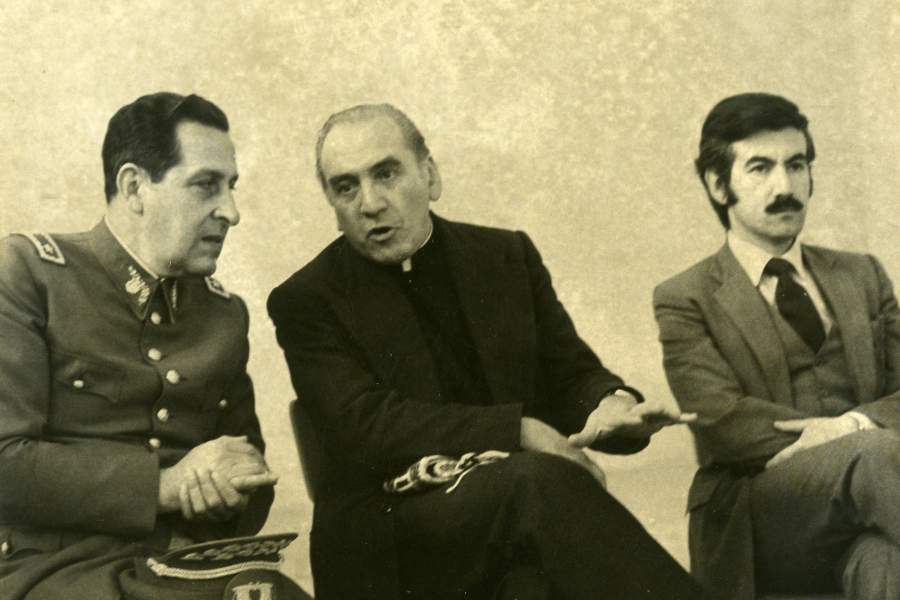
Jesuit Chilean priest Renato Poblete (center).
The other “new” frontier of the crisis lies in the cases of some of the “heroes” of the Catholic hierarchy, those willing to go to war for the Church using the ages-old tale of the homosexual bad priest, who despite all their public performances as aces of said war, were—in actuality, also predators in the same league as Maciel, Karadima, and many others.
One of them, is the former archbishop and former Cardinal of the Church Theodore McCarrick, a champion of all causes involving the Catholic Church in the United States, Latin America, and even China.
Despite such credentials now we know, through an official report issued by the Secretary of State of the Holy See, that he abused teenagers and young adults under his care who were seminary students. He did so since his days as priest in New York City in the 1960s. He continued to do so, until the early days of his retirement as emeritus arbishop of Washington, DC.
Other example is the French priest Tony Anatrella, who carved a niche of his own as expert in all things related to Catholic sexual teaching. He was the fierce captain of his own crusade in France against gay marriage and the adoption of kids by same-gender couples. Bishops and politicians on the right side of the French political spectrum used to quote him as the voice able to bring together the realms of scientific knowledge, traditional values, and Theology.
From the mid-1990s through the early 2010s, French cardinals and bishops sent their seminarians “having trouble” figuring out their own sexuality to Anatrella’s practice as psychoanalyst. His fame reached Rome, so Joseph Ratzinger first as prefect at the Congregation for the Doctrine of the Faith and later as Benedict XVI invited him to offer his very orthodox views on human sexuality.
This reseach article at Chicago Unbound, an academic journal, cites twelve examples of how influential was Anatrella in shaping the French bishops' and the Holy See's views on "gender ideology".
Anatrella achieved such feats because, as many other priests and lay persons in the Catholic and Evangelical worlds, he promised to cure homosexuality. Said cure is more relevant for Catholicism since its candidates to the priesthood must deal with their impulses while in the seminary with no expectation of having a stable heterosexual partner in life.
As far as it is possible to get from the testimonies published in the French media, Anatrella was trying to cure homosexuality with more homosexuality, performed by him. The cure was a dose of his exalted ego.
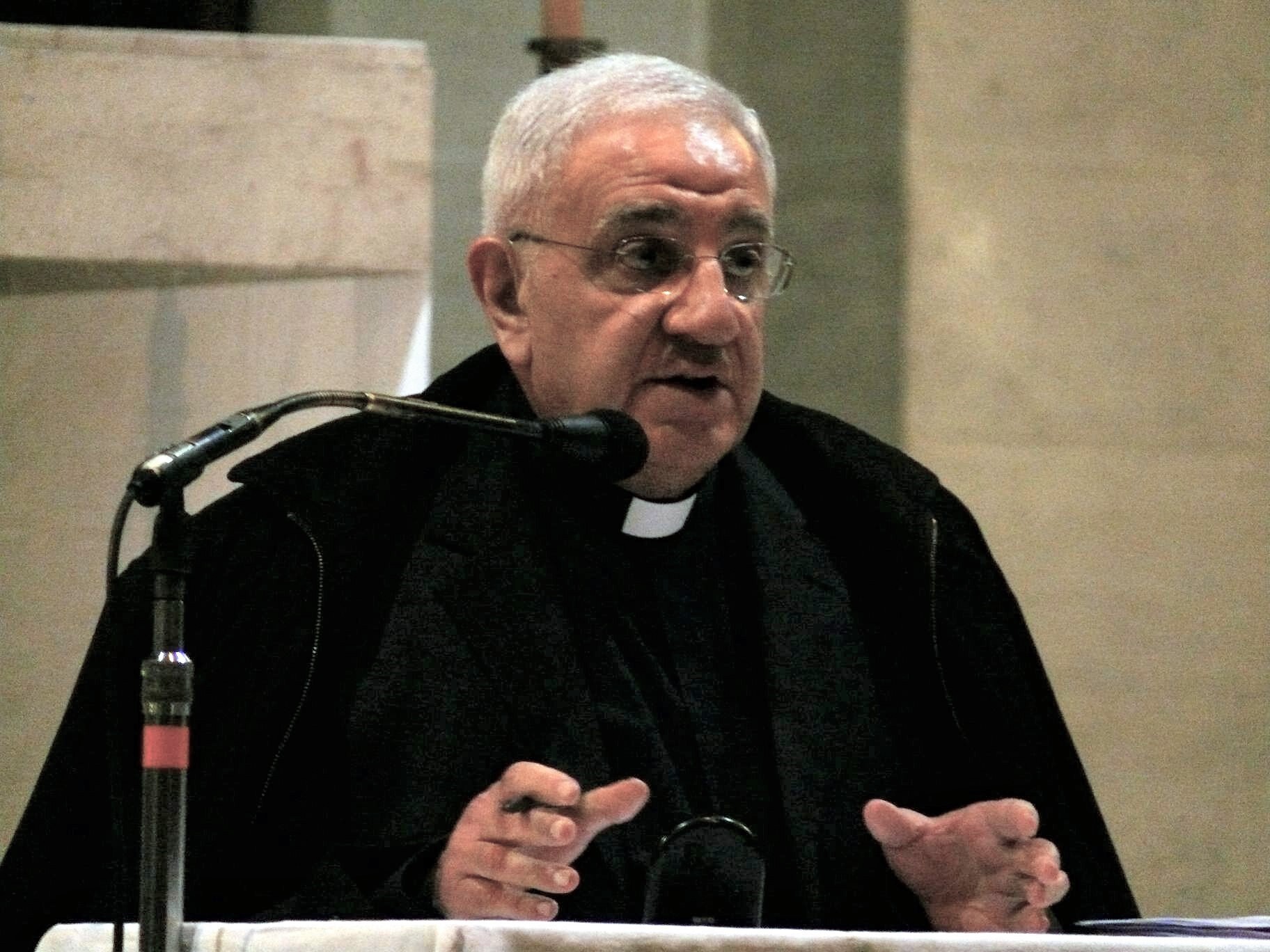
Tony Anatrella in 2012. Photo: Peter Potrowl
Predator as lone wolf
The accusations against Anatrella gained traction in the French media after some of his victims filed formal complaints and while other members of the French clergy expressed outrage at the way he was misquoting Scripture to fit his narrative in the books he published, the lectures he was offering, and interviews in French-speaking media.
Later, when the show was over, the explanation provided by the French hierarchy was once again the idea of the predator priest as some sort of “lone wolf”, acting on his own, with little or no knowledge by the leadership of the Church.
As with Maciel, Karadima, McCarrick or Carlos Miguel Buela in Argentina, the French bishops tried to portray Anatrella as the predator-as-lone-wolf, an individual able to weave powerful networks within the Church, to destroy the Church.

This was happening, however, almost 30 years after Berry discredited this idea of the predator-as-lone-wolf so dear to the Church’s hierarchy. First, he did it back in the 1980s with Gauthe’s case, later, he did it again when publishing books such as Lead us not into temptation (1992), Vows of silence (2004), and Render unto Rome (2011).
Despite that, Joseph Ratzinger, both as prefect of the Congregation for the Doctrine of the Faith and later as Pope Benedict XVI clung to the idea of the predator-as-lone-wolf, a predator acting on his own, with little or no knowledge from the bishops and other officials at the Church.
Richard Sipe, a former priest who, back in the 1960s, oversaw a program to retrain pedophile priests funded by the US National Conference of Bishops, put to rest the predator-as-lone-wolf argument when he coined the concept of the Scarlet Bond.
Back in 2010, eight years before his death, while reflecting on the chances of Benedict XVI stepping down from the papacy, he explained such concept:
Secrecy (the scarlet bond) within the Catholic clerical system is the cornerstone of the social construct of clerical celibacy and its violation. The reverence accorded to sacramental confession is stretched beyond all reason to cover and justify known clerical sexual violations and liaisons.
After Sipe it is almost impossible to believe in any bishop saying he was unaware of the abuse perpetrated by one of the priests under his care.
Sipe’s concept of Scarlet Bond is what renders absurd the original accounts provided by the Church’s top prosecutor of sexual abuse, Maltese archbishop Charles Scicluna, when he accounted for the two most damaging cases in Latin America: Marcial Maciel and Fernando Karadima. It is impossible to believe that both the Mexican and the United States bishops, in Maciel’s case, and the Chilean hierarchy in Karadima’s, had little or no knowledge of how both predators were able to perpetrate the abuse they came to be known for.
Despite Berry’s stories, Catholic top officials all over the world clung to the predator-as-lone-wolf narrative over and over.
The two most recent cases of bishops dealing with the aftermath of sexual abuse scandals, Bishop Richard Stika in Knoxville, the 100th Catholic prelate forced out of office so far, and German Cardinal and Archbishop Rainer Maria Woelki in Cologne, face the kind of issues they are facing as I write these lines precisely because of how they pretended they were unaware of abuse happening under their watch.
A database with all the names of the other 99 bishops that have been forced out of office, in some cases even laicized, as in Theodore McCarrick's case, will be published later in this series to commemorate the 40th anniversary of this stage of the sexual abuse crisis in the Catholic Church.
This is more relevant when one goes back to the Greek root of the word bishop, episcopos, that means he who watches. Their prime duty is to watch. And they do it.
In Latin America and elsewhere it was clear they were doing it when priests decided to mix and match Catholic Social Doctrine with Marxism. The punishment was immediate. When the issue was sexual abuse, the bishops were as aware of it as they were with “doctrinal failures.”
The issue is not whether the bishops act against a priest stepping out of line. That is their job. The issue is that they act swiftly against priests flirting with Liberation theology or other so-called heresies, but they go into “secrecy mode”, into the dynamics of the scarlet bond, when dealing with clergy sexual abuse.
Hence the relevance of Berry’s accountability-centered narrative. It has prevented top Church officials from using their dense, sometimes multinational, networks of friendship and loyalties to suppress public debate and denunciation of abuse, or of the scope and effects of the clergy sexual abuse crisis at large, or to influence the outcomes of specific cases when they go to trial.
However, one must be aware that said narrative needs something more than good journalists as Berry or good insight from someone like Sipe, who went from being part of the system put in place to control the crisis the critic of that system. Next week I will continue this overview of the state of the clergy sexual abuse crisis reaching its 40th anniversary.
Los jesuitas y el abuso sexual por clérigos católicos