Rodolfo Soriano-Núñez Domingo, 10 de Noviembre del 2024
Back in 2019, the Mexican nun told her then archbishop "I do not want more scandals in my Church, because I love her deeply".
The nun is still fighting for justice in Mexican courthouses. In Argentina, the police arrested a priest of the Schönstatt Institute, an "order" with a long history of covering up powerful predators in South America.
By Rodolfo Soriano-Núñez
In 1995, Myriam, an assumed name to protect the victim, was about to become a 15-year-old. When that happens, the vast majority of Mexican girls are about to celebrate the thanksgiving mass usually known as Quinceañera.
It is a time most Mexican families celebrate with immense pride. The young girls become the main character of a recurring story of happiness and the promise of a bright future for her and her relatives, including long dresses, elegant hats, and a painfully rehearsed dance.
The celebration allows families to pull material and symbolic resources together to throw a party marking that special moment. Myriam had no Quinceañera party for her because a few days before her birthday she was the victim of a rape.
The rape happened, of all places, at the Vocations Office of the then diocese of Tuxtla Gutiérrez, the capital city of Mexico’s southernmost state, located 500 miles or 800 kilometers Southeast of Mexico City.
Myriam’s is part of a wider and more complex process originally reported by the global NGO Bishop Accountability and their Mexican partners, Spes Viva (Living Hope in Latin).
Back on July 27th and 29th, 2023, Los Angeles Press published stories on the NGOs’ call for Mexican bishops to address pending cases of clergy sexual abuse and to stop covering up the abuses of the clergy under their supervision.

Mexico: 15 bishops and a nun cover up sexual abuse
The first story on the fifteen Mexican bishops and one mother superior named by both NGOs with records of covering up the predatory behavior of clerics under their supervision appears before this paragraph. The response of the Mexican Conference of Bishops appears after this paragraph.
Myriam was at the Vocations Office of the diocese, dressed as modestly as any girl her age would do when trying to figure out if being a nun was her calling. More so because she had already attended a Church-sponsored activity to bring potential seminarians and novices, and her family was active in the Roman Catholic Church.
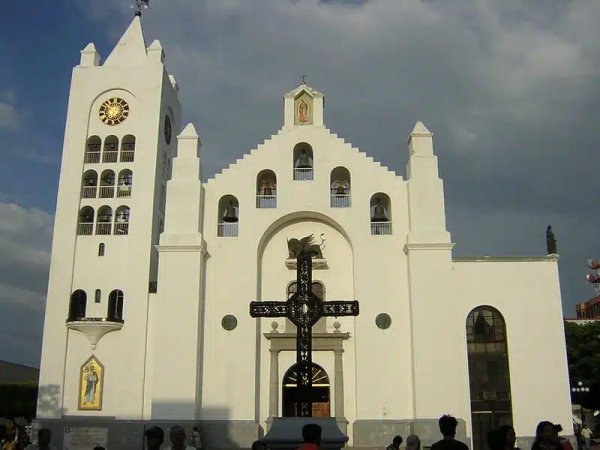
The meeting was scheduled at 4:00 PM in downtown Tuxtla Gutiérrez, a few yards from where Saint Mark’s Cathedral stands, but the nun then in charge of the feminine religious order of the Disciples of Jesus the Good Shepherd, never got there.

Myriam asked then seminarian Francisco Javier Albores Teco for the sister’s whereabouts. He was there because he was working with then director of Priestly Vocations at the diocese, Salvador Valadez Fuentes.
Instead of giving a straight answer Albores Teco told Myriam to wait for the nun. When Myriam was about to leave the office, more than an hour later, the seminarian running the office attacked her.
There is no need to go into the details of the attack as they are reported in the ecclesiastical files of which Los Angeles Press has an electronic copy.

Suffice to say at this point that in the file there are several accounts of what happened in that office in the early days of May 1995, and there is no real variation from one account to the other. On top of that, her accounts of the attack, offered as part of the ecclesiastical probe, are consistent with other similar cases.
30-year-long nightmare
Myriam was able to leave the Vocations Office of the diocese, but her 30-year-long nightmare was barely beginning. The nun asked her to come back, and she did, only to be the victim of a new attack. Again, Myriam was able to leave the office.
At a time when cell phones were not common, and landlines were scarce in Mexico, Albores Teco was able to get Myriam’s house number and threatened her with going to her house to attack her there, unless she went again to the same Vocations Office of the diocese of Tuxtla Gutiérrez. She did, to be victim yet again, only this time the abuse escalated to a full rape.
As it is frequent in these cases, Myriam went through a roller-coaster of emotions linked by the idea of blaming herself for what she suffered and being afraid of her parents’ possible reaction as she had been told repeatedly about the special status of clerics: “seminarians belong to God”, is what Myriam’s mother used to tell her when she was a little girl.
Albores Teco’s boss, then priest Salvador Valadez Fuentes, was a close associate of former bishop, now emeritus archbishop of Acapulco, Felipe Aguirre Franco who appointed him as head of the Vocations Office.
During his tenure at Tuxtla Gutiérrez (1988-2000), Aguirre Franco had also approved the foundation of the Disciples of Jesus the Good Shepherd order. Together with Aguirre Franco, Valadez Fuentes played a key role in the promotion and development of the order and, as far as it is possible to tell, in the development of an abuse-orientated culture at both the order and the Seminary of the then diocese of Tuxtla Gutiérrez.
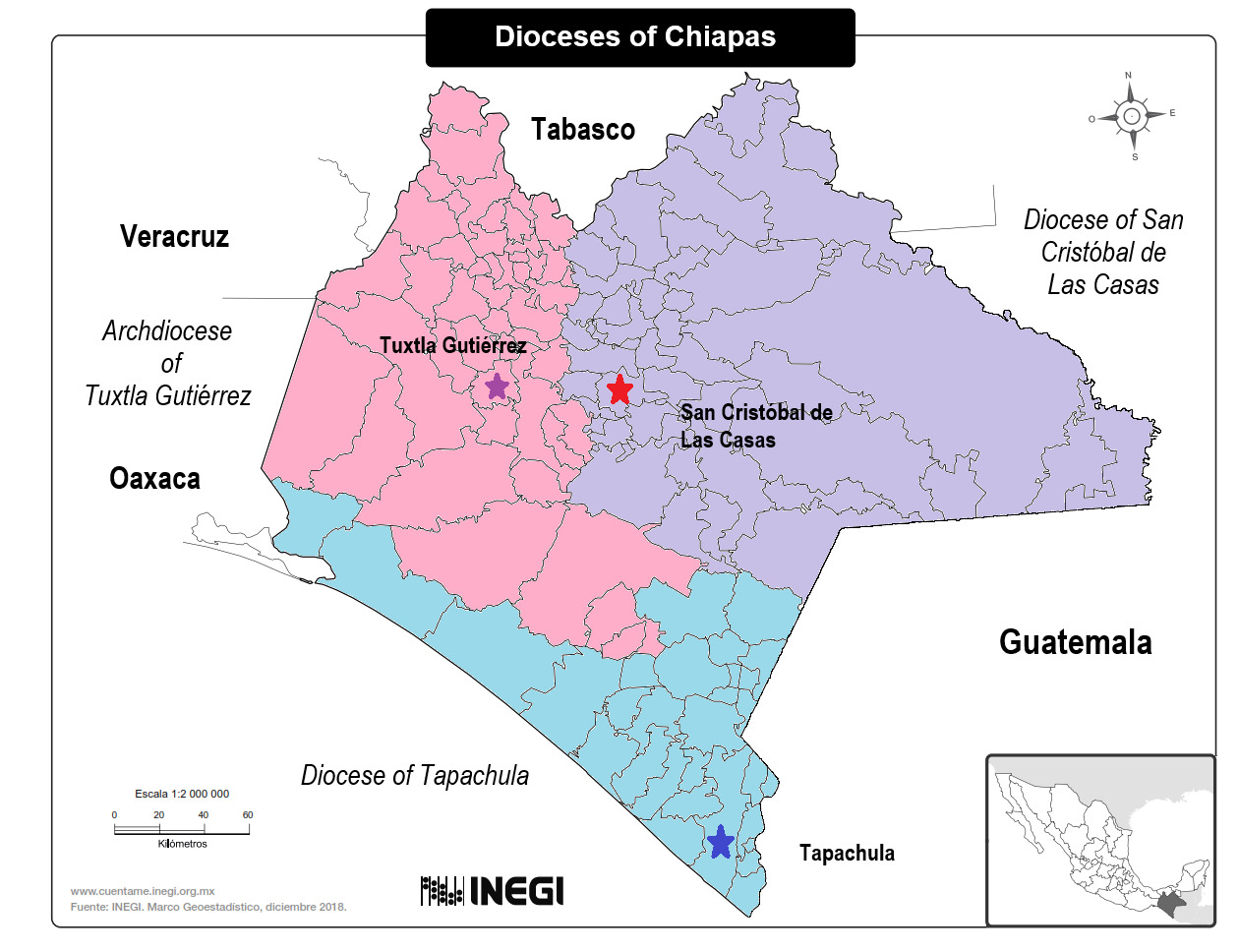
And even if Pope Benedict XVI “elevated” Tuxtla Gutiérrez to archdiocese in November 2006, taking it from a suffragan to the archdiocese of Oaxaca, to an archdiocese on its own, with the neighboring dioceses of San Cristóbal de Las Casas and Tapachula as its suffragans (see the map above), there was no change in the culture of abuse, sexual and otherwise, that Aguirre Franco allowed Valadez Fuente to instill there.
What is worse. After Aguirre Franco was promoted to archbishop of Acapulco, his replacement José Luis Chávez Botello, a real master of clergy sexual abuse cover up operations, arrived.
He was there from 2001 through 2003, when John Paul II sent him to Oaxaca, one of the few Mexican Roman Catholic dioceses where abuse has been so flagrant and obvious that documentaries as the one linked after this paragraph have been made and actual sentences with real jail terms served have been issued.
Silvestre. A documentary on clergy sexual abuse in the Oaxacan highlands. Audio available only in Spanish. Subtitles available through YouTube's control panel.
Even if Valadez Fuentes is not directly implicated in Myriam’s case, Pope Francis laicized him back on January 12th, 2022, after many accusations brought against him were accepted as valid by Rome.
There is official record as to how many victims accused Valadez Fuentes, as the statement from then archbishop Fabio Martínez Castilla, available as an image after this paragraph, tells.

When the highlighted paragraph in that statement talks about “the works that God has started for Evangelization’s sake” is talking about the Disciples of Jesus the Good Shepherd, stressing the idea that the order as such remained under the care of now deceased archbishop Martínez Casillas and the archdiocese of Tuxtla Gutiérrez.
Two years and a half after Valadez Fuentes’s defrocking or laicization, Rome issued the same “punishment” against Albores Teco, his former underling and disciple, as the document appearing next as image, dated October 24th, 2024, proves.

That does not mean Albores Teco is willing to accept his guilt. Quite the opposite. Even if in Rome there is little or no willingness to accept his version of the long story of abuse against Myriam, in the pending processes in courthouses in the state of Chiapas, he denies his role as predator.
He even tries to portray Myriam as waging some kind of personal vendetta against him, while using Myriam’s poor health, the byproduct of the clergy sexual abuse inflicted by him, to try to discredit her.
What is worse, for the last year or so, when his case was under review in Rome, Albores Teco saw fit becoming a fervent promoter of governor elect of Chiapas Eduardo Ramírez Aguilar, so chances are he is trying to get some help from the civil authorities to avoid some real punishment for many years of repeated sexual abuse against Myriam.
After this paragraph, it is possible to see his endorsement, at his personal Facebook page of the now governor elect Ramírez Aguilar. If it does not appear here, it is available here.
Not that the endorsement was especially popular, since it barely got one Like at Facebook, but the chances of Albores Teco trying to cash in old favors from the local political elites remain. Mexican civil and penal courthouses are known for odd rulings that have helped the ongoing attack on the Mexican Judiciary.
Not the only one
Myriam’s case is hardly the only one in Tuxtla Gutiérrez. Rome is not known for paying special consideration to a single victim. Albores Teco and his mentor, now former priest Valadez Fuentes, are part of a complex network of predator clerics at that archdiocese.
Next week I will provide more details of other episodes of clergy sexual abuse against Myriam and more importantly the disdainful attitude of her superiors at the order where she finally became a nun, the Missionary Servants of the Word, a feminine religious order with some presence in Ohio and Rhode Island in the United States, among other countries besides Mexico.
As it will be possible to confirm then, Myriam’s story opens the door to a better understanding of how abuse happens, and why it is impossible to believe in the idea of clergy sexual predators as “lone rangers”, as the original reports on Mexican and Chilean super predators Marcial Maciel and Fernando Karadima tried to tell us.
Myriam’s case all obliterates any pretense of blaming gay clergy as the sole culprits of the clergy sexual abuse crisis in the Roman Catholic Church. Her case adds up to the increasing evidence of females having similar or even higher chances of becoming victims of opportunistic predator clerics.

Not that we must throw away what celebrated reports published in the early years of this century as those coming from the John Jay College of Criminal Justice. It is just that in the initial stages of the crisis, it was mostly male victims who were willing to put aside their pain, illness, and other issues to talk about their experiences.
In Myriam’s as in many other cases the abuse was sexual, but also psychological and economic. Nuns and more broadly feminine religious personnel exist in many quarters in the Roman Catholic world, especially in the Spanish-speaking Roman Catholic world as cheap labor.
Comparable stories about the use of females in organizations resembling religious orders come from Buenos Aires in the case of the Opus Dei, from Lima, and other South American capitals in the case of the so-called Sodalitium, and even from Germany in the case of the so-called Das Werk (literally The Work in German).
What makes the Sodalitium so relevant?
Even if the Missionary Servants of the Word, the order where Myriam became a nun, nominally call their members “missionaries”, many of the work they do comes in the form of assistance, at office or domestic settings, to male clerics leading the territories of mission.
In that respect, the story will move from Chiapas, at the border with Guatemala, to the suburbs of Mexico City, to the diocese of Izcalli, where Los Angeles Press has documented at least another case of clergy sexual abuse, coming from the lack of standards in the Roman Catholic Church in Mexico when recruiting former seminarians of other dioceses.
If you read Spanish, you can go over the two installments on the case of Morseo Miramón Santiago, a priest originally from Acapulco, in the Mexican state of Guerrero, who for reasons unknown, left his studies at the seminary in that port in the Mexican Pacific, to reappear as a priest in Izcalli, where he abused at least one boy.

Sacerdote de Izcalli, acusado de abuso de un niño de 11 años
Our first installment of that series appears before this paragraph, the second is linked after.

Albores Teco’s and Valadez Fuentes’s cases are more relevant because the criminal organizations ravaging Chiapas and other states in Mexico already use clergy sexual abuse to force priests to become their accomplices or to pay for protection, as to avoid attacks on them or their relatives.
Back on October 21st, Los Angeles Press reported on the murder of priest Marcelo Pérez, right after he presided over mass near his home in San Cristóbal de Las Casas, in the same state of Chiapas where Tuxtla Gutiérrez is located, as the map a few paragraphs above shows.

Father Marcelo Pérez killed in Chiapas after presiding mass
After his burial, an audio emerged of a phone call Marcelo Pérez received from an unidentified local drug lord. Los Ángeles Press published the audio, available only in Spanish, in the story linked below.

Putting aside the fact that phone calls seeking to instill fear or to extort money or silence like the one Marcelo Pérez got are relatively common in Mexico and other Latin American countries, it must be noticed that the “hook” the caller used to intimidate Marcelo Pérez was to talk about one of the Mexican super sexual predator and former priest Eduardo Córdova Bautista.
He was also part of the cases behind Bishop Accountability’s and Spes Viva’s call to the Mexican conference of Roman Catholic bishops to stop covering up the sexual abuse of their priests, already linked above.
In that respect, the Mexican Bishops seem to be impervious to the effects of the clergy sexual abuse crisis. Myriam, still a nun, still a faithful Catholic, wrote a letter, back on February 5th, 2019, to the now deceased archbishop of Tuxtla Gutiérrez.

However, Monsignor, I am sure you understand better than I all that our Church is suffering at this time because of the clergy sexual abuses, many faithful are leaving their faith and others look at us with distrust, I have been the target of mockery and disqualification because of abuses against boys and girls by people who have suffered them. That is why I am trying to privately denounce Fr. Francisco (Javier Albores Teco) so that you are aware of what he did to me, because I am concerned that perhaps he is still damaging more girls, boys, or teens. We know for many studies done to pedophile predators that even if in remission, there is always the issue of latency, the chance of abusing more minors. My case has just prescribed for the purposes of Canon Law, I am 39 years-old, with the exception of the prescription for the specific case of scandal or similar.
I do not want to go public against Fr. Franciso (Javier Albores Teco) because I do not want more scandals in my Church, which I love deeply; but I do not want this type of acts to keep happening and remain in the dark, that is why I see as my duty to make you aware of these facts so that you do what you need to do and you will not become, unknowingly, the accomplice of cover up, and because I want what is most important: to protect the minors attending our churches. Pope Francis has asked zero tolerance in these cases.
It is really hard to follow Myriam, a nun who despite the abuse speaks with an authority it is hard to find in the leaders of the commissions dealing with clergy sexual abuse in the few, less than half, Mexican dioceses whose bishops are willing to attend Pope Francis’s request from 2019.

Schönstatt, again
In any case, it must be noticed that over the weekend the police in Córdoba, Argentina, 400 miles or 640 kilometers North of Buenos Aires, arrested Patricio Cruz Viale, a priest accused of clergy sexual abuse. The case is relevant because he is a member of the so-called Schönstatt Institute.
That is a relevant order because, on top of their extremely conservative theology and pastoral practices, they have a long story of covering up predator clerics.
One of the most notorious cases of clergy sexual abuse in Chile was that of the former archbishop of La Serena, Francisco José Cox Huneeus. He is one of the first cases of a bishop quietly dismissed by John Paul II to cover up repeated instances of clergy sexual abuse.
John Paul II accepted Cox Huneeus’s resignation to La Serena when he was only 63 years old. After his resignation he went to Germany, where he spent most of the rest of his life in some sort of golden cage, facing no consequences for the abuses he perpetrated while a priest and a bishop in his native Chile.
He was a member of the so-called Schönstatt Fathers. As with many of the “new” orders in the Roman Catholic Church, the Schönstatt bosses love to depict theirs not so much as an order, but as a “movement” of sorts, with an endless number of organizations and associations loosely connected between their ancestral homeland in Germany and their territories of “mission” in South America.
This 2020 story by Nicole Winfield at The Associated Press goes into the details of the accusations brought against the founder of that “order”. As can be seen there, Rome was aware that something odd was happening at Schönstatt but if they were unwilling to discipline Marcial Maciel, why would they do it with Josef Kentenich?
Cox Huneeus last names mean nothing outside of Chile, but in Chile they spell Chilean aristocracy, and the control that a handful of families exert over national institutions such as the Roman Catholic Church. If Cox Huneeus became archbishop, his cousin, Francisco Javier Errázuriz Ossa was appointed a Cardinal, and archbishop of the nation's capital, Santiago, and was ready to protect him.
First, he did it when Errázuriz Ossa became the global leader of the Schönstatt order; later, when he became the powerful secretary of the then Congregation now Dicastery in charge of the Roman Catholic orders in Rome, and then even more as archbishop of Santiago, from where he maneuvered to mute any public discussion of his cousin’s “sins” as archbishop of La Serena.
It would be only after Pope Francis’s disastrous trip to Chile and Peru, in 2018 that Rome reopened Cox Huneeus’s file, and the Argentine Pontiff decided to laicize him.
An adult female accused the Argentine priest, although it is not clear if the abuse happened when she was already an adult. Viale, the arrested priest faces now processes in both the civil and canonical tracks.
His order issued the statement that appears in the box after this paragraph, available here too in both Spanish and English.
A statement from the Argentine province of the Schönstatt Institute about the arrest of one of their members.
It is hard to believe in words coming from leaders of the Schönstatt Institute because of what Errázuriz Ossa did to deny, until the bitter end of his time at the Archdiocese of Santiago, that he was aware of the abuses perpetrated by Fernando Karadima.
The situation became so unbearable in the Chilean capital that the editorial committee of the archdiocesan newspaper resigned in full in early November 2015.
At the time, Errázuriz insisted that neither he nor the curia in Santiago were aware of Karadima's abuses. The implication was not only that he did not know. More important was to insist on the idea, present in the report on Maciel in Mexico, that the abuse was the work of a "lone predator".
As I write these lines, I confirm news of Spaniard priest and official of the Dicastery for the Doctrine of the Faith, Jordi Bertomeu being in Mexico.
I hope he is not here just to praise his fellow clergy, but to carry a probe at least as extensive as the one he did in Peru when dealing with the Sodalitium there.
Sadly, with so many cases here, it is almost impossible to figure out where in Mexico is Jordi Bertomeu doing his work.